edHelper.com
Health Professionals


School Counselors


School Counselors
Reading Level
     edHelper's suggested reading level:   grades 4 to 6
     Flesch-Kincaid grade level:   7.68

Vocabulary
     challenging words:    academic, bullied, certification, coping, counseling, diversity, divorce, goodman, popularity, reilly, testing, transition, well-being, assess, recruit, eleventh
     content words:    Frank Parsons, Vocational Guidance, Great Depression, World Wars, After Sputnik, United States, National Education Act


Print School Counselors
edHelper.com subscriber options:
     Print School Counselors  (font options, pick words for additional puzzles, and more)

     Quickly print reading comprehension

     Print a proofreading activity


Feedback on School Counselors
     Leave your feedback on School Counselors  (use this link if you found an error in the story)


School Counselors
By Jennifer Kenny
  

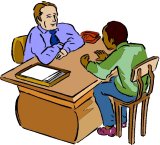
1     Are you unsure of what you might be good at when you grow up? Do you need help while you are struggling in math? Is a bully bothering you? Perhaps your school counselor might be able to assist you.
 
2     In the beginning of the 20th century, the first school guidance program was developed. It originally involved lessons around careers and character development. It was also a way to avoid behavior problems. Then it became a way to help older students make the transition, or change, from school to work when Frank Parsons established the Bureau of Vocational Guidance in 1908. School counseling grew from the 1920s to 1930s, but went down in popularity during the Great Depression. During the time of the World Wars, school counseling was used to recruit and select individuals to enter the military. After Sputnik was launched, the United States became concerned that Russia might be beating us in the areas of math and science. In order to encourage students to become scientists and mathematicians, the National Education Act was passed and a great deal of money went into vocational guidance.
 
3     School counselors encourage academic, career, and social development. While people often think of school counselors at the high school level, they also work at the elementary school and middle school level. Why? Well, school counselors consult with teachers, observe children in classes, create plans for problems, help family members, encourage career development and testing, and conduct personality testing. They conduct support groups for issues such as divorce or death, too.

Paragraphs 4 to 7:
For the complete story with questions: click here for printable


Copyright © 2008 edHelper