edHelper.com
Spanish American War (1898)


Latin American Freedom Fighters, Part 2 - After the War


Latin American Freedom Fighters, Part 2 - After the War
Reading Level
     edHelper's suggested reading level:   grades 7 to 9
     Flesch-Kincaid grade level:   5.43

Vocabulary
     challenging words:    autonomy, oust, regime, imperialism, ruling, self-rule, exile, invasion, reign, military, bloody, resolve, presence, refused, grief, fortune
     content words:    Puerto Rico, Mariana Islands, Juan Marina, Luis Muñoz Rivera, Muñoz Rivera, Puerto Ricans, Jones Act, Puerto Ricans U. S., Luis Muñoz Marín, Teller Amendment


Print Latin American Freedom Fighters, Part 2 - After the War
edHelper.com subscriber options:
     Print Latin American Freedom Fighters, Part 2 - After the War  (font options, pick words for additional puzzles, and more)

     Quickly print reading comprehension

     Print a proofreading activity


Feedback on Latin American Freedom Fighters, Part 2 - After the War
     Leave your feedback on Latin American Freedom Fighters, Part 2 - After the War  (use this link if you found an error in the story)


Latin American Freedom Fighters, Part 2 - After the War
By Toni Lee Robinson
  

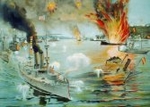
1     On December 10, 1898, envoys of Spain and the U.S. signed the Treaty of Paris. The "splendid little war" was over. The Spanish colonies of Cuba, the Philippines, Puerto Rico, and Guam came under U.S. control.
 
2     The victory was a big turning point for the U.S. America had surprised the world with its might and resolve. It emerged as a world power. It now held colonies like the great nations of Europe. Some people in the U.S. thought it was high time for the nation to expand. For many people, the issue raised a big question. America had fought for its own liberty, they said. How could a nation that believed in freedom practice imperialism (acquiring colonies and ruling over them)?
 
3     The main impact of the war, of course, wasn't felt by the two countries who signed the peace treaty. It was absorbed by the people of Spain's former colonies. They had struggled for many bloody years against the Spanish rulers. Then the Americans had swept in and defeated Spain. The long battle for freedom was over, right?
 
4     No one from the colonies themselves had been invited to the peace talks, however. Many citizens of Cuba, the Philippines, and Puerto Rico were uneasy. Had the war between Spain and America simply brought a new colonial master to replace the old? In some cases, many years would pass before the question was fully answered.
 
5     Guam: Stuck on the far southern tip of the Mariana Islands, Guam hadn't played much part in the war. As a Spanish territory, however, it was invaded by the U.S. in June 1898. The cannons of the U.S.S. Charleston roared as the ship cruised into range. Guam's Spanish governor, Juan Marina, was shocked to find out the cannon fire wasn't a good will salute. The surprised governor hadn't heard about the war. The only guns on the island were relics, not safe to fire. There was no powder with which to fire them anyway. Marina surrendered Guam without firing a shot. Today, it remains a U.S. territory.
 
6     Puerto Rico: Before the war, Luis Muñoz Rivera had convinced Spain to allow Puerto Rico a measure of self-rule. The U.S. invasion brought a quick end to the first steps toward autonomy. At war's end, a military government was set up. Offices were filled by U.S. appointees. Muñoz Rivera didn't like the U.S. plan. He continued to work for freedom.
 
7     Muñoz Rivera took his case to the U.S. itself. He represented Puerto Rico in the U.S. Congress. In that position, he pushed for liberty for Puerto Ricans. Muñoz Rivera died in 1916. The next year, Congress passed the Jones Act, making Puerto Ricans U.S. citizens. The measure had been authored by Muñoz Rivera before his death.
 
8     Finally, in 1947, Puerto Rico won the right to elect its own governor. Luis Muñoz Marín, son of Muñoz Rivera, became the island's first elected governor. Since then, Puerto Rico has taken more steps toward autonomy. It is still, however, a territory of the U.S.

Paragraphs 9 to 16:
For the complete story with questions: click here for printable


Copyright © 2008 edHelper