edHelper.com
Ancient China
The 1970's


An Army for the Dead


An Army for the Dead
Reading Level
     edHelper's suggested reading level:   grades 5 to 7
     Flesch-Kincaid grade level:   6.53

Vocabulary
     challenging words:    pharaohs, element, infantry, burning, lavish, cavalry, spears, dated, Archeologists, drilling, universe, mass, excavation, mercury, entire, power
     content words:    Qin Dynasty, Qin Shi Huang, Emperor Qin


Print An Army for the Dead
edHelper.com subscriber options:
     Print An Army for the Dead  (font options, pick words for additional puzzles, and more)

     Quickly print reading comprehension

     Print a proofreading activity


Feedback on An Army for the Dead
     Leave your feedback on An Army for the Dead  (use this link if you found an error in the story)


An Army for the Dead
By Jane Runyon
  

1     Many rulers have wanted to be remembered after their deaths. Egyptian pharaohs had pyramids built. These pyramids were tombs for their bodies and warehouses for their treasures. The first Emperor of the Qin Dynasty in China chose a different kind of memorial for himself.
 
2     Workers began construction on the tomb of Qin Shi Huang in 246 B.C. Historians have concluded that this tomb was to be big enough for the emperor and a large store of the treasure he had collected. The inside of the tomb was to look like the universe. The ceiling was set with pearls and other jewels to represent the stars and planets. The bodies of water on the earth were made of mercury. You may have seen this flowing, silver element in a thermometer. The actual tomb has not yet been entered. Scientists have, however, discovered evidence of high levels of mercury in the soil. This has led them to believe that stories of the lavish tomb are true.
 
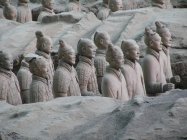
3     The Qin emperor chose a very unusual way to protect his tomb. He wanted his army to surround him, even in death. Craftsmen created life-sized soldiers, horses, and chariots that were buried around the tomb. These figures were made of terra cotta. Terra cotta means "baked earth." Red clay is formed into an object and then put into an oven, or kiln, to bake slowly. Once the object has been baked, a lacquer is applied to give it a shiny, hard finish. Perhaps you have seen a terra cotta flower pot or terra cotta tiles on the roof of a house. Terra cotta is fragile. It can chip easily when kept in the sun for too long.

Paragraphs 4 to 8:
For the complete story with questions: click here for printable


Copyright © 2008 edHelper