edHelper.com
Renaissance


Martin Luther


Martin Luther
Reading Level
     edHelper's suggested reading level:   grades 6 to 8
     Flesch-Kincaid grade level:   7.9

Vocabulary
     challenging words:    far-reaching, pilgrimage, negative, sins, translation, refused, hymn, authority, theology, plan, reform, debate, spiritual, wealth, literature, leader
     content words:    Martin Luther, Protestant Reformation, Lutheran Church, South America, Catholic Church, Holy Land, Ninety-five Theses, Wittenburg Castle Church, Puritan Churches, Small Catechism


Print Martin Luther
edHelper.com subscriber options:
     Print Martin Luther  (font options, pick words for additional puzzles, and more)

     Quickly print reading comprehension

     Print a proofreading activity


Feedback on Martin Luther
     Leave your feedback on Martin Luther  (use this link if you found an error in the story)


Martin Luther
By Sharon Fabian
  

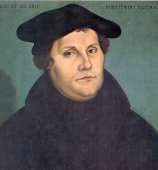
1     Martin Luther didn't plan to start a new church, much less change the course of history. Yet, he did both of those things. Martin Luther was the leader of the Protestant Reformation movement that was the beginning of the Lutheran Church as well as many other protestant churches that followed. The effects of the Reformation were felt all over Europe and even as far away as North and South America.
 
2     What Martin Luther did hope to do was to make improvements in his own church, the Catholic Church. Like many other religious people before him, Martin Luther was troubled by the problems he saw in the Church. The Church had grown rich and powerful. Some of its activities seemed more about accumulating wealth and influence than about spiritual matters.
 
3     The church had, for years, preached that a person could obtain forgiveness for his sins by doing good works, for example - going on a pilgrimage to the Holy Land. More recently, however, it had begun to allow people to buy forgiveness by donating money to the church. The sale of these indulgences had become a big business. Martin Luther, a Catholic priest, thought that it was all wrong.
 
4     According to Martin Luther's beliefs, the decision about who would be forgiven was up to God, not the Church. A person could not buy forgiveness. All he had to do was to have faith in God.
 
5     In 1517, Martin Luther published his ideas where everyone could see them. He nailed his Ninety-five Theses to the door of the Wittenburg Castle Church. Luther was a professor in Wittenburg, and it was not all that unusual at the time for ideas to be posted in this way so that scholars could debate them.

Paragraphs 6 to 11:
For the complete story with questions: click here for printable


Copyright © 2008 edHelper