edHelper.com
Transportation


The Piston Push


The Piston Push
Reading Level
     edHelper's suggested reading level:   grades 5 to 7
     Flesch-Kincaid grade level:   9.48

Vocabulary
     challenging words:    accelerator, air-gasoline, bolted, camshaft, combust, converge, crankshaft, ignition, In-line, injector, internal-combustion, manifold, muffler, piston, Piston-type, throttle


Print The Piston Push
edHelper.com subscriber options:
     Print The Piston Push  (font options, pick words for additional puzzles, and more)

     Quickly print reading comprehension

     Print a proofreading activity


Feedback on The Piston Push
     Leave your feedback on The Piston Push  (use this link if you found an error in the story)


The Piston Push
By Trista L. Pollard
  

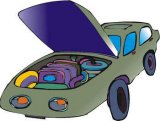
1     What's under the hood of your parents' car? A reciprocating engine lies there, and that is the reason your parents' car has the power to move forward down the street. Reciprocating engines combust or burn fuel inside cylinders within the engine. Similar to other internal-combustion engines (like diesel), reciprocating engines contain pistons that help to convert heat into mechanical energy. Piston-type gasoline engines are the most common type of engines used in automobiles. Let's look inside to see energy at work.
 
2     Cylinders in reciprocating engines can be arranged in four different ways. Automobiles with V-engines have two banks or rows of cylinders that angle towards each other at one end to form a V. In-line engines contain only a single bank of cylinders within the engine block. W-engines are similar to V-engines. These engines have banks of cylinders that are arranged in alternate pairs of opposite cylinders. The banks of cylinders then converge or come together to form two V's. Finally, cylinders that are arranged horizontally (they are usually arranged vertically) in opposite rows are called pancake, flat, or boxer engines. When an automobile has a V-8 engine, this means that the engine has eight cylinders that are in banks that form a V. Most cars have four-, six-, or eight-cylinders in the engine. This allows one cylinder to always provide power while the other cylinders are at different points within their cycles.
 
3     In internal-combustion engines the piston reciprocates or moves back and forth during strokes or cycles. Gasoline and diesel engines are usually four-stroke engines. This means that it takes four strokes of the piston to produce the mechanical energy necessary for the car. The pistons in the cylinders go through their strokes at different times so that the pistons are working efficiently and not in unison. The pistons in each cylinder have a rod attached at the top. The rod is connected to a crankshaft or turning lever. As the piston reciprocates, it rotates the crankshaft. The crankshaft which is connected to the drive wheels of the automobile helps to power the car and move it forward. The engine speed is known as crankshaft revolutions per minute. Now that we have the turning of parts, let's see what provides the heat.

Paragraphs 4 to 7:
For the complete story with questions: click here for printable


Copyright © 2008 edHelper