edHelper.com
Earth


Earth Movers - Glaciers


Earth Movers - Glaciers
Reading Level
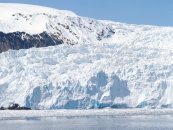
     edHelper's suggested reading level:   high interest, readability grades 5 to 7
     Flesch-Kincaid grade level:   4.4

Vocabulary
     challenging words:    recrystallizes, bedrock, mini, erosion, continental, sediment, depression, landscape, mass, latitude, press, hemisphere, U-shaped, powerful, form, cause
     content words:    Great Lakes


Print Earth Movers - Glaciers
edHelper.com subscriber options:
     Print Earth Movers - Glaciers  (font options, pick words for additional puzzles, and more)

     Quickly print reading comprehension

     Print a proofreading activity


Feedback on Earth Movers - Glaciers
     Leave your feedback on Earth Movers - Glaciers  (use this link if you found an error in the story)


Earth Movers - Glaciers
By Patti Hutchison
  

1     Have you ever made a snowball with your hands? You pick up some snow and press it together in you hands. It quickly freezes into ice. If you have done this, you have made a "mini" glacier.
 
2     Real glaciers, of course, are much, much larger. But they are formed in the same way. Glaciers are mostly found in areas of high latitude or high elevation. These places have cold temperatures all year. Snow falls and never completely melts. The weight of the snow on top causes pressure on the layers of snow beneath. The snow underneath recrystallizes into ice.
 
3     Glaciers cover about ten percent of the earth today. Even at the peak of the last ice age, only about thirty percent of the earth was covered. But glaciers made their mark in much of the northern hemisphere.
 
4     There are two types of glaciers - continental glaciers and valley glaciers. Continental glaciers cover huge areas. As you can guess, they can be as big as continents. They are thickest in the middle. The pressure in the middle causes the glacier to spread out and cover large areas. Today these glaciers cover Antarctica and parts of Greenland and Canada.
 
5     A valley glacier is much smaller than a continental glacier. They form in areas with high mountains. They form when a mass of ice becomes too thick. The weight causes it to start to move slowly down the valley. Deep cracks form in the ice.

Paragraphs 6 to 11:
For the complete story with questions: click here for printable


Copyright © 2008 edHelper