edHelper.com
Life Science


DNA Structure


DNA Structure
Reading Level
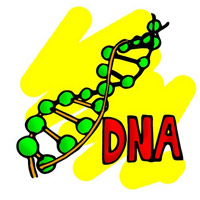
     edHelper's suggested reading level:   grades 6 to 8
     Flesch-Kincaid grade level:   7.12

Vocabulary
     challenging words:    deoxyribonucleic, enzyme, phosphorus, synthesis, blueprint, nucleus, chromosome, complement, complementary, radiation, ferret, mutation, finding, criminal, strands, nitrogen


Print DNA Structure
edHelper.com subscriber options:
     Print DNA Structure  (font options, pick words for additional puzzles, and more)

     Quickly print reading comprehension

     Print a proofreading activity


Feedback on DNA Structure
     Leave your feedback on DNA Structure  (use this link if you found an error in the story)


DNA Structure
By Cindy Grigg
  

1     An embryonic cell divides again and again. Where there was one cell there are two, then four, then eight, and so on. Each holds all the genetic information needed to create a new human being. Your fingernails grow nonstop, day in and day out. The cells of your fingernails somehow generate all of the protein that makes up your nails. How is this protein created? How, exactly, do these cells make copies of themselves? The answers to these questions are DNA replication and protein synthesis.
 
2     When organisms reproduce, traits are passed from parent to offspring. These traits are carried in DNA, the genetic material found in a cell's nucleus. DNA acts like a blueprint for the cells of an organism, instructing the cells how to put together materials to produce certain traits.
 
3     DNA stands for deoxyribonucleic acid (pronounced de-ox-ee-ribe-o-new-clee-ick as-id). It's made of just a few kinds of atoms: carbon, hydrogen, oxygen, nitrogen, and phosphorus. The traits that make organisms different from one another are coded for in their DNA. Chromosomes are made of DNA. Chromosomes are genetic structures that contain the information used to direct a cell's activities and make new cells. They are found in the nucleus of a cell.
 
4     A person has 46, or 23 pairs, of chromosomes. Our cells have two copies of each chromosome. One came from the mother, and one from the father. The chromosome starts as half of the familiar X. As the cell grows, it replicates the DNA to make the other half of the X, which is identical. When the cell divides, each daughter cell receives half of each chromosome (called a chromatid). The two copies of the gene are alike on one chromosome but the "matching" pair of chromosomes may have slightly different genes (dominant or recessive alleles) as one came from the mother and one from the father. The dominant gene of the two is the one that is expressed. For example, if one parent gives a gene that carries the trait for blue eye color and the other parent gives a gene that carries the trait for brown eye color, the child would have brown eyes. The trait for brown eye color is dominant, and that is the color that would be expressed in the child.
 
5     DNA is a very large molecule with a shape like a twisted ladder. You have probably heard of the DNA molecule referred to as a double-helix. The rungs of the ladder are made up of molecules called bases. These nucleotide bases are adenine, thymine, guanine, and cytosine. The bases always pair up so that adenine is joined with thymine (A-T) and cytosine is joined with guanine (C-G). Each rung of the ladder is made of two bases - one for each side of the ladder.

Paragraphs 6 to 11:
For the complete story with questions: click here for printable


Copyright © 2008 edHelper