edHelper.com
Transportation


Satellites


Satellites
Reading Level
     edHelper's suggested reading level:   grades 7 to 9
     Flesch-Kincaid grade level:   9.48

Vocabulary
     challenging words:    high-resolution, infrared, launches, celestial, transmitter, reconnaissance, surveillance, nuclear, missile, transmit, eavesdrop, launched, atmosphere, orbit, military, broadcast
     content words:    Hubble Space Telescope, Atlantic Ocean, United States Navy, Navigation Satellite, Time Ranging/Global Positioning Satellite System, Asian Tsunami, United Soviet Socialist Republic


Print Satellites
edHelper.com subscriber options:
     Print Satellites  (font options, pick words for additional puzzles, and more)

     Quickly print reading comprehension

     Print a proofreading activity


Feedback on Satellites
     Leave your feedback on Satellites  (use this link if you found an error in the story)


Satellites
By Trista L. Pollard
  

1     
Satellite bright, satellite bright,
Will you be the first satellite I see tonight?
Orbiting above our sky so high,
Sending signals to cell phones and televisions nearby....

 
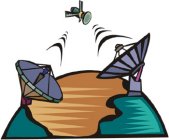
2     The poem is right about satellites orbiting above our planet. However, unlike stars, we do not see these satellites in our sky at night. The moon is the earth's natural satellite. Satellites are objects that revolve around another object. Scientists have designed the many satellites that orbit our planet. Once in orbit, they need to move at an orbital velocity of five miles per second (8 kilometers per second) to stay in orbit. When a satellite slows down, it leaves its orbit and falls back to earth. The satellite burns up when it enters earth's atmosphere.
 
3     Each satellite has a radio transmitter to send signals and a receiver to pick up signals. This allows the satellite to send information back to earth. Scientists can also control the satellite from earth. They send signals to tell the satellite to turn on or off or to change position. There are five types of satellites. Research satellites are used to take measurements in outer space. These satellites send back information about magnetic fields and properties of other planets and other celestial objects we cannot see from earth. One famous research satellite is the Hubble Space Telescope.

Paragraphs 4 to 8:
For the complete story with questions: click here for printable


Copyright © 2008 edHelper