edHelper.com


The Greatest Storms on Earth, Part I


The Greatest Storms on Earth, Part I
Reading Level
     edHelper's suggested reading level:   grades 6 to 9
     Flesch-Kincaid grade level:   8.36

Vocabulary
     challenging words:    inward-spiraling, subside, formation, millibars, landfall, drastic, violent, heated, equivalent, meteorologists, bands, massive, cumulonimbus, compression, tremendous, powerful
     content words:    United States, South Atlantic, South Pacific, Caribbean Sea, North America, Pacific Ocean, Indian Ocean, North Pacific Ocean, North Atlantic, In The Greatest Storms


Print The Greatest Storms on Earth, Part I
edHelper.com subscriber options:
     Print The Greatest Storms on Earth, Part I  (font options, pick words for additional puzzles, and more)

     Quickly print reading comprehension

     Print a proofreading activity


Feedback on The Greatest Storms on Earth, Part I
     Leave your feedback on The Greatest Storms on Earth, Part I  (use this link if you found an error in the story)


The Greatest Storms on Earth, Part I
By Trista L. Pollard
  

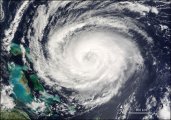
1     Some of the greatest and most powerful storms on Earth are hurricanes. In fact, the energy of one hurricane is almost equivalent to a year's supply of electrical energy in the United States. This startling fact may help you understand the tremendous power of a hurricane.
 
2     Hurricanes are violent, whirling storms that have sustained wind speeds above 74 miles (119 kilometers) per hour and up to 185 miles (300 kilometers) per hour. U.S. meteorologists calculate sustained winds by taking the average of the wind speeds they observe over a period of one minute. These winds are very different from the gusts you feel outside on a cool fall day. Gusts are strong, sudden bursts of wind.
 
3     Most of our planet's hurricanes are born in tropical oceans between 5 degrees latitude and 20 degrees latitude. You may be surprised to know that they do not occur in the South Atlantic and eastern South Pacific oceans. Some hurricanes develop off the coast of Africa. They travel westward making their way to the Caribbean Sea or up the eastern coast of North America. As hurricanes cross the oceans, they can produce 50-foot (15-meter) waves. These same waves can cause tremendous damage hundreds of miles away from their starting point. Once hurricanes reach land or make landfall, they cause a huge number of deaths and injuries. The strong winds, torrential rain, and massive flooding destroy property which will require billions of dollars to restore.

Paragraphs 4 to 6:
For the complete story with questions: click here for printable


Copyright © 2008 edHelper