edHelper.com
Ancient Greece


Plato


Plato
Reading Level
     edHelper's suggested reading level:   grades 6 to 8
     Flesch-Kincaid grade level:   7.78

Vocabulary
     challenging words:    aristocracy, aristocratic, oligarchy, ruling, schooldays, staunch, stemmed, timocracy, tyranny, dialogue, city-state, penned, corrupting, commit, dominance, influential
     content words:    Byzantine Empire, When Plato, Because Socrates, Only Plato


Print Plato
edHelper.com subscriber options:
     Print Plato  (font options, pick words for additional puzzles, and more)

     Quickly print reading comprehension

     Print a proofreading activity


Feedback on Plato
     Leave your feedback on Plato  (use this link if you found an error in the story)


Plato
By Vickie Chao
  

1     When it comes to philosophers, ancient Greece had many big names. Among them, Plato was perhaps the most influential.
 
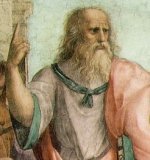
2     Originally named Aristocles, Plato was born to a rich family in 427 B.C. or 428 B.C. (Plato means "broad" in Greek. It was a nickname that Aristocles acquired during his schooldays. The name probably stemmed from his physical appearance -- broad shoulders.) When he was in his twenties, he met Socrates and became his student. (Some sources said that Plato and Socrates were actually friends.) At the time, Socrates was a leading thinker in Athens. He liked to hold dialogues with people and encourage them to question everything around them. His unique approach (called the Socratic method) did not sit well with many people. It especially made the authorities very nervous. In 399 B.C., the officials in Athens arrested Socrates. They accused him of corrupting the youth. At the trial, a panel of jurors found him guilty. They sentenced him to death. As a staunch supporter of Socrates, Plato felt that the Athenians treated his teacher most unfairly. Out of disgust, he left Athens and stayed abroad for several years.
 
3     In probably around 387 B.C., Plato returned to Athens. He opened up a school called the Academy. The school was long considered the first university in Europe. It taught many subjects, such as biology, mathematics, astronomy, and, of course, philosophy. Plato ran the Academy himself from the very beginning to the day he died. After he passed away in 348 B.C. or 347 B.C., the school remained open for nearly another 900 years. It was eventually closed down by Justinian I of the Byzantine Empire in 529 A.D.

Paragraphs 4 to 6:
For the complete story with questions: click here for printable


Copyright © 2008 edHelper