edHelper.com


What Is Primitivism?


What Is Primitivism?
Reading Level
     edHelper's suggested reading level:   grades 4 to 6
     Flesch-Kincaid grade level:   7.18

Vocabulary
     challenging words:    botanical, brightly-feathered, cavemen, dark-skinned, entrancing, inspiration, lottery, moods, mystical, self-taught, wild-eyed, Yadwigha, exotic, society, artistic, rests
     content words:    These African, Paul Gauguin, Henri Rousseau, Sleeping Gypsy, Modern Art, New York, Snake Charmer


Print What Is Primitivism?
edHelper.com subscriber options:
     Print What Is Primitivism?  (font options, pick words for additional puzzles, and more)

     Quickly print reading comprehension

     Print a proofreading activity


Feedback on What Is Primitivism?
     Leave your feedback on What Is Primitivism?  (use this link if you found an error in the story)


What Is Primitivism?
By Colleen Messina
  

1     If you hear the word "primitivism," you might think of hairy cavemen chasing wooly mammoths. If you then learn that it was a kind of art, you might think of cavemen swiping spiky brushes across cave walls, painting pictures of wooly mammoths. Primitivism actually was a 19th century art style famous for its exotic scenes and wildlife.

 
2     During that time, many European countries invaded parts of Africa. These African tribes had a unique culture. Their masks and other art objects looked exciting to the Europeans. The African artists used geometric patterns, animals, and bright colors. European artists saw this and thought Wow, let's paint like this! Soon, they invented Primitivism.
 
3     This style of art looked flat. The colors were bright. Often, the artist applied the paint in a rough way. Then, the painting looked raw and unfinished. Artists who painted in this style tried to get away from anything that reminded them of modern society. They often painted faraway places. For example, Paul Gauguin painted scenes of natives and beaches on the island of Tahiti.
 
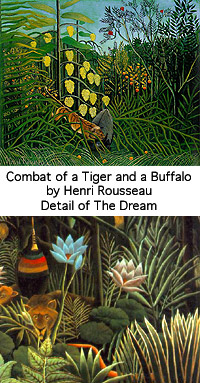
4     Animals often appear in these paintings, too. French artist Henri Rousseau painted exotic jungles populated by wild-eyed lions, slithering snakes, and brightly-feathered birds. Fantastically lush trees and ferns made his artwork seem mystical, even though he never visited a real jungle. His inspiration came from local botanical gardens, and Henri never traveled to exotic places. But he was still able to capture the magical mood of the jungle in his artwork.

Paragraphs 5 to 11:
For the complete story with questions: click here for printable


Copyright © 2008 edHelper