edHelper.com
Ancient Rome
Spartacus


Spartacus
Reading Level
     edHelper's suggested reading level:   grades 6 to 8
     Flesch-Kincaid grade level:   7.08

Vocabulary
     challenging words:    determined, fasces, frontline, showdown, standing, turn-around, largely, onset, jurisdiction, rebellion, bloody, reclaim, auxiliary, heyday, defy, legacy
     content words:    Ancient Rome, Mount Vesuvius, Claudius Glaber, Publius Varinius, Lucius Gellius Publicola, Cnaeus Cornelius Lentulus Clodianus, Marcus Licinius Crassus, When Crassus, Via Appia, Since Pompey


Print Spartacus
     Print Spartacus  (font options, pick words for additional puzzles, and more)


Quickly Print - PDF format
     Quickly Print: PDF (2 columns per page)

     Quickly Print: PDF (full page)


Quickly Print - HTML format
     Quickly Print: HTML


Proofreading Activity
     Print a proofreading activity


Feedback on Spartacus
     Leave your feedback on Spartacus  (use this link if you found an error in the story)


Spartacus
By Vickie Chao
  

1     Ancient Rome had a lot of marvels. Back in the heyday, the Romans put up many spectacular structures. Some of them still remain standing today. As we admire the civilization that ancient Rome left behind, we must keep one thing in mind. Rome's glory was built largely on the backs of countless slaves.
 
2     Slaves played an important role in ancient Rome. Aside from doing construction, they also worked as servants at bathhouses or private homes. They took part in public games, fighting as gladiators. They labored away in farms. As slaves, they had little control over their lives. They had to do everything they were told. If they refused to take orders, they could get beaten up. If they tried to escape, they could even be killed. Once sold, most slaves simply resigned themselves to their fate. Of the few who rose up to defy the Romans, Spartacus was the most famous.
 
3     Spartacus was actually not a slave by birth. According to a popular account, he once served in the Roman army as an auxiliary. For reasons unknown to us, he deserted the army and ran away. Unfortunately, he was not able to elude the Romans for long. After being caught, he was sold into slavery and began his rigorous training as a gladiator in Capua. In 73 B.C., Spartacus broke out of the gladiatorial school with over seventy followers. To fend for themselves, they used knives and other kitchen tools as weapons. Once they managed to escape the school compound, they went straight to hide on Mount Vesuvius nearby.
 
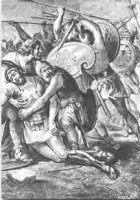
4     The Romans were not pleased with this turn of events. Fearing more slaves would join Spartacus's forces, they wanted to crush the uprising quickly. The first one up for the challenge was Claudius Glaber. Glaber and his army of 3,000 had success at the beginning. They besieged the rebels on a hill and blocked the only path leading to the top. They thought that a victory was at hand, but they were wrong. Using vines as ropes, Spartacus and his men climbed down the other slippery side of the mountain undetected. Once they reached the ground, they circled around and ambushed Glaber's troops. As the Roman soldiers ran for their lives in haste, Spartacus ordered his followers to haul away the discarded weapons for future use.
 
5     Disappointed by the defeat, the Roman senate replaced Claudius Glaber with Publius Varinius. It also doubled the army to a legion of 6,000 men. When the two sides clashed later that year, the Romans suffered another defeat. To make matters worse, this time they even lost their fasces. Fasces were bundles of rods tied together with an ax. They were the Romans' symbol for power and jurisdiction.

Paragraphs 6 to 13:
For the complete story with questions: click here for printable


Copyright © 2009 edHelper