edHelper.com
Sports


Sumo Wrestling


Sumo Wrestling
Reading Level
     edHelper's suggested reading level:   grades 4 to 6
     Flesch-Kincaid grade level:   6.2

Vocabulary
     challenging words:    embody, lasting, mutual, rigorous, wrestlers, ideal, definitely, resolve, circular, strategy, professional, good-sized, spite, matches, religion, sacred
     content words:    Japanese Sumo, Japan Sumo Association, World War II, Sumai Parties


Print Sumo Wrestling
edHelper.com subscriber options:
     Print Sumo Wrestling  (font options, pick words for additional puzzles, and more)

     Quickly print reading comprehension

     Print a proofreading activity


Feedback on Sumo Wrestling
     Leave your feedback on Sumo Wrestling  (use this link if you found an error in the story)


Sumo Wrestling
By Colleen Messina
  

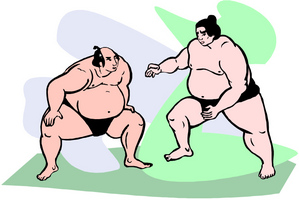
1     For many sports, the ideal athlete's body is sleek, muscular, and lean. However, one sport requires a different kind of body. Japanese Sumo wrestlers pride themselves on being as big as possible.
 
2     The ancient art of Sumo wrestling goes back to the 8th century. A long time ago, wrestling meant fighting to the death. Gradually, it became a sport where the goal of each wrestler was to throw his opponent to the ground. By the 16th century, the wrestlers fought in a ring and wore loose loincloths. Today, professional Sumo wrestling is organized by the Japan Sumo Association and its members, who are called oyakata. These men used to be wrestlers, and they train new wrestlers.
 
3     Sumo wrestling is the national sport of Japan. It is also part of the centuries-old Shinto religion. Shinto was the state religion of Japan until World War II. Shinto worships kami gods. These sacred spirits embody elements such as wind, rain, trees, and rivers. Human beings become kami after death and are worshiped by their families. Shinto ritual includes a dance where a wrestler fights with a kami. These contests are called Sumai Parties, but they aren't as much fun as birthday parties. They are held at Shinto places of worship called shrines. Sometimes, Sumo wrestling was used to resolve political conflicts.

Paragraphs 4 to 9:
For the complete story with questions: click here for printable


Copyright © 2008 edHelper