edHelper.com
Sports


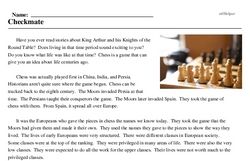
Checkmate


Checkmate
Reading Level
     edHelper's suggested reading level:   grades 3 to 5
     Flesch-Kincaid grade level:   4.47

Vocabulary
     challenging words:    pawn, ranking, strategy, cases, actually, medieval, society, wage, powerful, stories, ever, upper, comfort, power, exactly, often
     content words:    King Arthur, Round Table, From Spain, Early Europeans


Print Checkmate
edHelper.com subscriber options:
     Print Checkmate  (font options, pick words for additional puzzles, and more)

     Quickly print reading comprehension

     Print a proofreading activity


Feedback on Checkmate
     Leave your feedback on Checkmate  (use this link if you found an error in the story)


Checkmate
By Jane Runyon
  

1     Have you ever read stories about King Arthur and his Knights of the Round Table? Does living in that time period sound exciting to you? Do you know what life was like at that time? Chess is a game that can give you an idea about life centuries ago.
 
2     Chess was actually played first in China, India, and Persia. Historians aren't quite sure where the game began. Chess can be tracked back to the eighth century. The Moors invaded Persia at that time. The Persians taught their conquerors the game. The Moors later invaded Spain. They took the game of chess with them. From Spain, it spread all over Europe.
 
3     It was the Europeans who gave the pieces in chess the names we know today. They took the game that the Moors had given them and made it their own. They used the names they gave to the pieces to show the way they lived. The lives of early Europeans were very structured. There were different classes in European society. Some classes were at the top of the ranking. They were privileged in many areas of life. There were also the very low classes. They were expected to do all the work for the upper classes. Their lives were not worth much to the privileged classes.

Paragraphs 4 to 10:
For the complete story with questions: click here for printable


Copyright © 2008 edHelper