edHelper.com
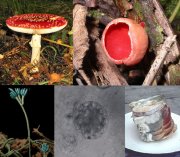
Life Science


Fungi - Friends or Foes?


Fungi - Friends or Foes?
Reading Level
     edHelper's suggested reading level:   grades 3 to 6
     Flesch-Kincaid grade level:   4.16

Vocabulary
     challenging words:    absorb, asthma, dutch, molds, penicillin, plural, sweaty, tangy, material, mass, wherever, fungus, container, avocado, refrigerator, roots
     content words:    North America


Print Fungi - Friends or Foes?
edHelper.com subscriber options:
     Print Fungi - Friends or Foes?  (font options, pick words for additional puzzles, and more)

     Quickly print reading comprehension

     Print a proofreading activity


Feedback on Fungi - Friends or Foes?
     Leave your feedback on Fungi - Friends or Foes?  (use this link if you found an error in the story)


Fungi - Friends or Foes?
By Cindy Grigg
  

1     They're all around you. Open a door, and thousands of them float inside. They are too small for you to see. They are looking for food. Some land on a piece of bread, an orange, or an open jar of jam. Others land on damp clothes, a shower curtain, or sweaty socks. They leave fuzz behind wherever they have been eating. The fuzz can be blue, white, green, black, or pink.
 
2     Outside, millions of them feed on trees and flowers. Others feed on insects and even animals. Some eat wooden things like porches, fences, decks, and steps. Fungi feed on them until these things fall apart. Other fungi help plants and trees grow. They provide food for thousands of creatures. Many of them are nature's recyclers. Who are they? They are fungi (one is a fungus).
 
3     A fungus can be only one cell. Most fungi are more than one cell. Fungi cannot make their own food. Some fungi grow on foods that we eat. Some fungi grow on bread. We call it mold. Other kinds of fungi grow on living things. They can make the other living things sick. Mushrooms are fungi that get food from dead matter in the soil.
 
4     For hundreds of years, people thought that fungi were plants. Now they are classified into a separate group all by themselves. There are three main things that make fungi different from plants.
 
5     First, plants have roots, leaves, and flowers. Plants can use their leaves to make their own food from the sun's energy. Fungi have no leaves, flowers, or roots like plants do. They can't make their own food. Fungi feed on living or dead matter around them.
 
6     Second, plants are made from a material called cellulose. Fungi are made of chitin. Chitin is a tough material that is found in the outer skeletons of insects. Chitin is not found in plants.
 
7     Third, most plants reproduce, or make more of themselves, by making seeds in their flowers. Fungi reproduce in other ways.
 
8     Most fungi begin their lives as spores. Spores are tiny. When they land on something wet, they begin growing. The spore begins to grow a long thin tube called a hypha (plural: hyphae). The hyphae (say: hi-FEE) ooze powerful chemicals called enzymes. The enzymes slowly digest the food for the fungi. Unlike animals, fungi digest their food outside of their bodies. Then they absorb through the hyphae the nutrients that are released.
 
9     The hypha grows in many directions. Each hypha is like a tiny thread. They are a thousand times smaller than a human hair. In a few days, the hypha is twisting, turning, and branching back on itself. It begins to look like a mass of cobwebs. The only thing we can see is a little fuzz.

Paragraphs 10 to 16:
For the complete story with questions: click here for printable


Copyright © 2008 edHelper