edHelper.com
A Tale of Health Care


A Tale of Health Care
Reading Level
     edHelper's suggested reading level:   grades 1 to 3
     Flesch-Kincaid grade level:   2.97

Vocabulary
     challenging words:    grade, second, costs, kinds, alone, answer, aunt, believe, care, choose, class, cost, country, different, doctor, each
     content words:    United States, In Britain, Great Britain


Print A Tale of Health Care
     Print A Tale of Health Care  (font options, pick words for additional puzzles, and more)


Quickly Print - PDF format
     Quickly Print: PDF (2 columns per page)

     Quickly Print: PDF (full page)


Quickly Print - HTML format
     Quickly Print: HTML


Proofreading Activity
     Print a proofreading activity


Feedback on A Tale of Health Care
     Leave your feedback on A Tale of Health Care  (use this link if you found an error in the story)


A Tale of Health Care
By Jennifer Kenny
  

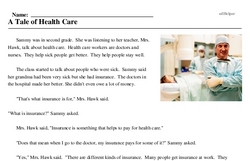
1     Sammy was in second grade. She was listening to her teacher, Mrs. Hawk, talk about health care. Health care workers are doctors and nurses. They help sick people get better. They help people stay well.
 
2     The class started to talk about people who were sick. Sammy said her grandma had been very sick but she had insurance. The doctors in the hospital made her better. She didn't even owe a lot of money.
 
3     "That's what insurance is for," Mrs. Hawk said.
 
4     "What is insurance?" Sammy asked.
 
5     "In the United States," Mrs. Hawk said, "insurance is something that helps to pay for health care."
 
6     "Does that mean when I go to the doctor, my insurance pays for some of it?" Sammy asked.
 
7     "Yes," Mrs. Hawk said. "There are different kinds of insurance. Many people get insurance at work. They may have to pay for some of it or all of it."
 
8     "Are all plans the same?" Carrie asked.

Paragraphs 9 to 23:
For the complete story with questions: click here for printable


Extended Activities:

1.  Look up in a book or talk to someone about what a doctor does. Write a job description for a doctor.

2.  Ask people around you about their health insurance. Do they like what they have? Do they think the system needs to change?


Copyright © 2009 edHelper