edHelper.com
2008 Elections


Embryonic Stem Cell Research


Embryonic Stem Cell Research
Reading Level
     edHelper's suggested reading level:   grades 6 to 8
     Flesch-Kincaid grade level:   11.61

Vocabulary
     challenging words:    amniotic, fertilization, fetus, long-term, deflect, hearing, social, medium, colony, controversial, laboratory, pursue, diabetes, direct, original, loss
     content words:    Carl Zeiss Axiovert, National Institutes, Regenerative Medicine, Wake Forest University School, North Carolina, Presidential Race


Print Embryonic Stem Cell Research
edHelper.com subscriber options:
     Print Embryonic Stem Cell Research  (font options, pick words for additional puzzles, and more)

     Quickly print reading comprehension

     Print a proofreading activity


Feedback on Embryonic Stem Cell Research
     Leave your feedback on Embryonic Stem Cell Research  (use this link if you found an error in the story)


Embryonic Stem Cell Research
By Susan Radtke
  

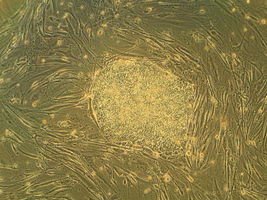
1     Caption: A colony of embryonic stem cells, from the H9 cell line (NIH code: WA09). Viewed at 10X with Carl Zeiss Axiovert scope.
 
2     In the hope of obtaining votes, candidates in the 2008 election must take a stand on many controversial issues. Embryonic stem cell research is one such topic. People are in favor of this type of research because it may aid in great advances in therapy for curing diseases. The opposition argues that it should be eliminated because there are alternatives available that do the same thing without destroying life.
 
3     To form an opinion, one must first understand the process. According to the National Institutes of Health, embryonic stem cells are derived from embryos that develop from eggs that have been fertilized in an invitro fertilization clinic and then donated for research. Slightly different but more controversial, the embryos from which human embryonic stem cells are derived are typically four to five days old and are a hollow ball of cells called a blastocyst, and if left to mature would become a fetus in four to six weeks. Cells are taken from the inner layer of the blastocyst and placed in a plastic laboratory dish that contains a broth known as a culture nutrient medium. The cells divide and grow in the dish. When the dish becomes crowded, cells are transferred to other dishes.

Paragraphs 4 to 8:
For the complete story with questions: click here for printable


Copyright © 2008 edHelper