edHelper.com
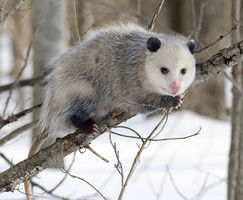
Mammals


Opossums


Opossums
Reading Level
     edHelper's suggested reading level:   grades 5 to 6
     Flesch-Kincaid grade level:   5.79

Vocabulary
     challenging words:    housing, mechanism, crossing, koala, opportunists, unattended, frequently, automatic, reality, based, rarely, phrase, opossum, gain, value, odor
     content words:    North America


Print Opossums
edHelper.com subscriber options:
     Print Opossums  (font options, pick words for additional puzzles, and more)

     Quickly print reading comprehension

     Print a proofreading activity


Feedback on Opossums
     Leave your feedback on Opossums  (use this link if you found an error in the story)


Opossums
By Mary Lynn Bushong
  

1     What animal looks like a giant rat but isn't one? It has a prehensile tail like some monkeys, but it isn't one of those either. It has more teeth in its mouth than any other mammal, yet it is nearly defenseless. Do you know what it is? It's an opossum [uh-POSS-um].
 
2     In many ways, opossums look like something left over from prehistoric times. Their mouths have fifty teeth, and their naked tails are used like a fifth foot.
 
3     Opossums also have a lower body temperature than other mammals. This means they are often slower to move around on cold nights. This is a real problem when they are crossing a busy road. In another way, this lower body temperature is of great benefit. Opossums rarely get rabies.
 
4     What opossums lack in good looks, they gain in uniqueness. They are the only marsupials native to North America. In fact, they are thought to be distant cousins to the koala of Australia.
 
5     Baby opossums are born tiny and undeveloped. They find their way to their mother's pouch and latch on to one of 13 or more nipples located there. They do not let go for at least two months, at which point they emerge from the pouch. After that they might ride on their mother's back. By the time the babies are about four months old, they are on their own.

Paragraphs 6 to 12:
For the complete story with questions: click here for printable


Copyright © 2008 edHelper