'); } var S; S=topJS(); SLoad(S); //-->
![]() edHelper.com Ancient Rome |
Mt. Vesuvius and the City of Pompeii |
| edHelper's suggested reading level: | grades 7 to 9 | |
| Flesch-Kincaid grade level: | 7.81 |
| Print Mt. Vesuvius and the City of Pompeii (font options, pick words for additional puzzles, and more) |
| Quickly Print: PDF (2 columns per page) |
|
| Quickly Print: PDF (full page) |
| Quickly Print: HTML |
| Print a proofreading activity |
| Leave your feedback on Mt. Vesuvius and the City of Pompeii (use this link if you found an error in the story) |
|
Mt. Vesuvius and the City of Pompeii
By Vickie Chao |
|
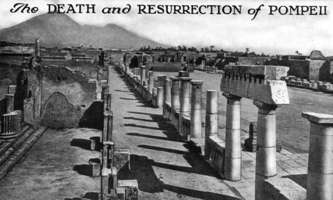
1 To people in Pompeii, August 24, 79 A.D., started out like every normal day. The streets were bustling with activities. People were busy going to and from their various destinations. Then, all of a sudden, around 1 o'clock in the afternoon, they saw a column of smoke bursting out from Mount Vesuvius. Astonished as they were, they knew that this was not time to idle. They had to make a run for it right away. Some left town immediately, not knowing exactly where they should go. Others hurried back home to pack up valuables and plan their next move. In the midst of this chaos, a hail of pumice stones and volcanic rocks began to pour into the city. The smell of sulfur filled the air. The day became a horrifying nightmare. Nineteen hours later, the eruption of Mount Vesuvius finally stopped. The city of Pompeii was gone, buried underneath 9 feet of volcanic ash! For the next 1,500 years or so, the site remained undisturbed and completely forgotten. It might have still been the case had the architect Domenico Fontana (1543 A.D. - 1607 A.D.) not decided to dig a new water conduit in the late 16th century. While he surveyed the area, he discovered the ruins of Pompeii by chance. But nothing more was done until Charles III, King of Naples and Sicily, came along and ordered a systematic excavation in 1748 A.D. What he found was a city frozen in time. It was truly amazing!