edHelper.com
Skeletal System
Take a Tour of the Skeletal System, Part 2


Take a Tour of the Skeletal System, Part 2
Reading Level
     edHelper's suggested reading level:   grades 3 to 5
     Flesch-Kincaid grade level:   2.86

Vocabulary
     challenging words:    cartilage, hinge, lower, adult, marrow, works, repair, direction, upper, compare, below, index, ribs, holds, fact, collar
     content words:    Read Take, Skeletal System Part


Print Take a Tour of the Skeletal System, Part 2
     Print Take a Tour of the Skeletal System, Part 2  (font options, pick words for additional puzzles, and more)


Quickly Print - PDF format
     Quickly Print: PDF (2 columns per page)

     Quickly Print: PDF (full page)


Quickly Print - HTML format
     Quickly Print: HTML


Proofreading Activity
     Print a proofreading activity


Feedback on Take a Tour of the Skeletal System, Part 2
     Leave your feedback on Take a Tour of the Skeletal System, Part 2  (use this link if you found an error in the story)


Take a Tour of the Skeletal System, Part 2
By Cindy Grigg
  

1     The skeletal system is the name of the bones in your body. Your skeleton gives your body shape. It holds you up. It protects your soft organs like your heart and lungs. It works with muscles to help you move. Your bones are alive, just like the rest of your body. They grow and change as you grow.
 
2     When you were born, you had about 300 bones. An adult only has 206 bones. That's because many of the bones fuse or grow together as people grow up. Many baby bones are made of cartilage. Cartilage is like the end of your nose. It is tough and flexible. As babies grow, the cartilage turns into hard bone. It needs lots of calcium to do this. That's why it is important for kids to drink lots of milk. You can get calcium from yogurt, ice cream, and cheese, too.
 
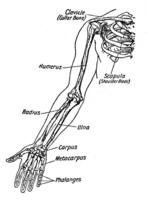
3     At your shoulder, bones called the clavicle and the scapula form a socket. The bone from the top of your arm, called the humerus, is a ball joint that fits into this socket. This ball and socket joint rotates so that you can turn your arm in any direction.
 
4     Put your fingers on the front of your neck. Move your fingers down your chest. The first bones you feel just below your neck are the clavicles. The common name is collar bones. Below these, you can feel your ribs. You have twelve ribs on each side (twelve pairs) or 24 ribs. They curve around your heart and lungs to protect them. You can feel your ribs move when you breathe.
 
5     Your upper arm has one large bone, the humerus. At the end of this bone near your elbow is the "funny bone." When you bump this bone, it's not funny at all! It hurts! That's because you have hit the nerve that runs along the humerus.

Paragraphs 6 to 12:
For the complete story with questions: click here for printable


Copyright © 2009 edHelper