edHelper.com
The 2000's
Trans-Asian Railway


Trans-Asian Railway
Reading Level
     edHelper's suggested reading level:   grades 6 to 8
     Flesch-Kincaid grade level:   7.46

Vocabulary
     challenging words:    dual, traveler, gauge, rails, crossing, millimeter, reality, breakup, solution, port, paperwork, booming, existence, directly, route, economy
     content words:    Silk Road, Middle Ages, United Nations, Soviet Union, Cold War, Trans-Asian Railway Network, Iron Silk Road, Southeast Asia, South Korea, Trans-Asian Railway Network Agreement


Print Trans-Asian Railway
     Print Trans-Asian Railway  (font options, pick words for additional puzzles, and more)


Quickly Print - PDF format
     Quickly Print: PDF (2 columns per page)

     Quickly Print: PDF (full page)


Quickly Print - HTML format
     Quickly Print: HTML


Proofreading Activity
     Print a proofreading activity


Feedback on Trans-Asian Railway
     Leave your feedback on Trans-Asian Railway  (use this link if you found an error in the story)


Trans-Asian Railway
By Sharon Fabian
  

1     In ancient times, traders traveled back and forth between Asia and Europe carrying goods for sale. They brought silks, satins, rubies, and diamonds from merchants in Asia to consumers in Europe. The routes that they traveled became known, all together, as the Silk Road.
 
2     After hundreds of years as an important trading route, the Silk Road fell out of use during the Middle Ages when sea travel became the preferred method of transportation for traders. Goods have been traveling back and forth by sea ever since those days.
 
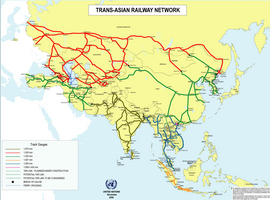
3     Then in the 1960s, there was a new interest in a good land route between Europe and Asia. Of course, there were already highways and railways, too, but there wasn't one unified system. There was no one route to take a traveler from Europe all the way to port cities on the Pacific coast of China. So the United Nations began to look into the idea of a single railway system that could do the job.
 
4     For years, there was only slow progress on the idea. Then in the 1990s with the breakup of the Soviet Union and the end of the Cold War, people looked forward to a booming economy, and interest in the railway was renewed. Plans were revived for a system that would be called the Trans-Asian Railway Network.

Paragraphs 5 to 13:
For the complete story with questions: click here for printable


Copyright © 2009 edHelper