edHelper.com
The 2000's
GIOVE Satellites Pave the Way for Galileo


GIOVE Satellites Pave the Way for Galileo
Reading Level
     edHelper's suggested reading level:   grades 6 to 8
     Flesch-Kincaid grade level:   9.1

Vocabulary
     challenging words:    atomic, economic, radiation, launched, military, navigator, orbit, tested, reflector, testing, unit, astronomer, direct, phase, technology, mission
     content words:    Global Navigation Satellite System, Galileo Galilei, United States, Galileo In-Orbit Validation Element, Baikonur Cosmodrome, United Kingdom


Print GIOVE Satellites Pave the Way for Galileo
     Print GIOVE Satellites Pave the Way for Galileo  (font options, pick words for additional puzzles, and more)


Quickly Print - PDF format
     Quickly Print: PDF (2 columns per page)

     Quickly Print: PDF (full page)


Quickly Print - HTML format
     Quickly Print: HTML


Proofreading Activity
     Print a proofreading activity


Feedback on GIOVE Satellites Pave the Way for Galileo
     Leave your feedback on GIOVE Satellites Pave the Way for Galileo  (use this link if you found an error in the story)


GIOVE Satellites Pave the Way for Galileo
By Sharon Fabian
  

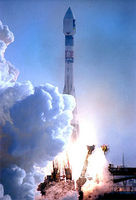
1     In 2005, Europe launched the satellite that would be the first part of the newest and most up-to-date Global Navigation Satellite System. This new system would be known as Galileo.
 
2     It is named after the famous astronomer and navigator Galileo Galilei. Galileo discovered the first four moons of Jupiter. He discovered that the four moons could be used as a clock and that they could also be used to determine longitude here on earth. His discoveries helped sailors in ancient times to navigate the seas, so his name is a perfect choice for the newest global navigation system.
 
3     There are already other navigation systems in place. GPS systems are used in the United States, and GLONASS systems are used in Russia. When it is completed, Galileo will work with these two other systems. It can also be used independently if needed. Europe will no longer have to depend on using the US or the Russian system.
 
4     The satellite launched in 2005 was named GIOVE A. GIOVE stands for Galileo In-Orbit Validation Element. It was the first of many satellites in the Galileo project. A second satellite, GIOVE B, was launched in 2008. Both satellites were launched from Baikonur Cosmodrome in Kazakhstan. Both traveled into space on a Soyuz rocket.
 
5     Each satellite has a central part packed with equipment. On both sides, stretching out like the wings on an airplane, there are large solar panels. The satellites carry a payload including an antenna, a signal generating unit, atomic clocks, a radiation monitor, a navigation receiver, and a laser reflector.

Paragraphs 6 to 11:
For the complete story with questions: click here for printable


Copyright © 2009 edHelper