edHelper.com
Weather
What Are Hurricanes?


What Are Hurricanes?
Reading Level
     edHelper's suggested reading level:   grades 4 to 6
     Flesch-Kincaid grade level:   4.67

Vocabulary
     challenging words:    cyclone, landfall, affected, shoreline, heading, surge, warning, rare, pumps, rotation, spiral, exactly, lines, emergency, often, picture
     content words:    Southern Hemisphere, South Atlantic Ocean, National Weather Service


Print What Are Hurricanes?
     Print What Are Hurricanes?  (font options, pick words for additional puzzles, and more)


Quickly Print - PDF format
     Quickly Print: PDF (2 columns per page)

     Quickly Print: PDF (full page)


Quickly Print - HTML format
     Quickly Print: HTML


Proofreading Activity
     Print a proofreading activity


Feedback on What Are Hurricanes?
     Leave your feedback on What Are Hurricanes?  (use this link if you found an error in the story)


What Are Hurricanes?
By Cindy Grigg
  

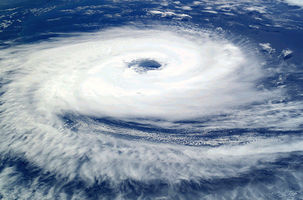
1     Caption: This picture taken by the ISS shows a rare Southern Hemisphere cyclone (that is why it shows a clockwise rotation).
 
2     Hurricanes form over warm ocean water. Most of them form in the South Atlantic Ocean. They only form in the summer and early autumn months. Without the heat of the warm ocean during the summer months, hurricanes could not form. No one knows exactly what causes hurricanes.
 
3     We do know that during the months of May to November, large areas of very low pressure form over the surface of the ocean. Warm, moist air rises, creating low pressure areas. Cooler air pushing down from the north begins to take its place. The moving air begins to swirl, and a tropical cyclone begins.
 
4     A tropical cyclone can be seen on radar. The rain clouds that form a tropical cyclone make a spiral. The spiral swirls counterclockwise. It looks like a giant doughnut. The hole in the middle is called the eye of the storm. The eye is an area of very low pressure. It is an area of calm while the storm swirls around it.

Paragraphs 5 to 12:
For the complete story with questions: click here for printable


Copyright © 2009 edHelper