edHelper.com
The 2000's
Women Vote in Kuwait


Women Vote in Kuwait
Reading Level
     edHelper's suggested reading level:   grades 6 to 8
     Flesch-Kincaid grade level:   7.98

Vocabulary
     challenging words:    proposal, suffrage, air-conditioned, corruption, decision-making, supporter, candidate, discrimination, legislative, recognition, democratic, eligible, reform, provided, political, public
     content words:    Female Kuwaiti, Khaledah Al Khadher, REUTERS/Stephanie McGehee, National Assembly, Election Day, Many Kuwaiti, Middle East


Print Women Vote in Kuwait
     Print Women Vote in Kuwait  (font options, pick words for additional puzzles, and more)


Quickly Print - PDF format
     Quickly Print: PDF (2 columns per page)

     Quickly Print: PDF (full page)


Quickly Print - HTML format
     Quickly Print: HTML


Proofreading Activity
     Print a proofreading activity


Feedback on Women Vote in Kuwait
     Leave your feedback on Women Vote in Kuwait  (use this link if you found an error in the story)


Women Vote in Kuwait
By Sharon Fabian
  

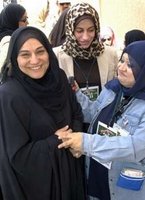
1     Caption: Female Kuwaiti candidate Khaledah Al Khadher (L) talks with a supporter at a polling place in Kuwait. Photo: REUTERS/Stephanie McGehee
 
2     The 2006 election in Kuwait was an historic event. It was the first time that women could vote in that country.
 
3     The total number of women eligible to vote made up about sixty percent of the electorate. So politicians running for office wanted to be sure to appeal to women voters.
 
4     They held special events to speak to the women voters. Some events were held in air-conditioned tents with comfortable chairs and food provided. Campaign staffers were on hand to answer the women's questions. The politicians made their speeches and made sure to include issues that women were especially interested in.
 
5     The big issue for everyone in this election was political reform. In fact, the election was being held a year early to address that very problem. Since the twenty-five election districts in Kuwait were very small, politicians who promised the most to their local community had often won elections in the past. There was little campaigning on national issues. Corruption, including the buying and selling of votes, was a big problem. Because of these issues, the emir of Kuwait had dissolved the National Assembly, Kuwait's legislative body, and called for this election a year earlier than scheduled.
 
6     To address the problem of the election districts that were too small, there was a proposal to change to only five larger districts. Reform candidates, both women and men, campaigned on a platform that promised to make this change.
 
7     About two hundred fifty candidates, including twenty-seven women, ran in the election. They were competing for just fifty seats, two from each of the twenty-five districts.
 
8     Since the election had been moved up a year, women had little time to prepare a campaign. They had little time to win support or even name recognition.

Paragraphs 9 to 17:
For the complete story with questions: click here for printable


Copyright © 2009 edHelper