edHelper.com
Birds
Turkeys


Turkeys

A Short Reader

Reading Level
     edHelper's suggested reading level:   grades 3 to 6
     Flesch-Kincaid grade level:   3.74

Vocabulary
     challenging words:    mating, over-hunting, grunt, adult, bronze, male, copper, nearly, gobble, base, longer, mile, fold, loose, afternoon, bumpy
     content words:    North America


Print Turkeys
     Print Turkeys  (font options, pick words for additional puzzles, and more)


Quickly Print - PDF format
     Quickly Print: PDF (2 columns per page)

     Quickly Print: PDF (full page)


Quickly Print - HTML format
     Quickly Print: HTML


Proofreading Activity
     Print a proofreading activity


Feedback on Turkeys
     Leave your feedback on Turkeys  (use this link if you found an error in the story)


Turkeys
By Vickie Chao
Rewritten as a short reader by Cindy Grigg
  

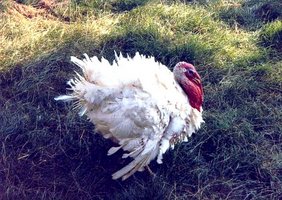
1     Turkeys are big birds. There are two groups. One kind of turkey is grown on farms to be eaten. They are called domestic turkeys. Wild turkeys were here when the first settlers came. Domestic turkeys are much bigger than wild turkeys. Domestic turkeys usually have white feathers. They are so heavy that they can no longer fly. Wild turkeys can fly and run well. They can run at 25 miles per hour!
 
2     Wild turkeys are native to North America. They are the largest game birds here. Game birds are hunted for sport. Pheasants, ducks, and quails are other examples of game birds. Turkeys nearly became extinct by the early 1900s. This was caused by over-hunting. It was also caused by people taking over the turkeys' habitat. People cut down many trees.
 
3     Turkeys' heads and necks have almost no feathers. The head and neck is covered with red bumpy skin. The red skin will change to blue when the turkeys are scared or excited. The males can raise their tail feathers to form a fan. Male turkeys have long wattles at the base of their bills and at their throats. A wattle is a loose fold of skin. Turkeys are also known to have "beards" on their chests. These "beards" are really feathers, not hairs.

Paragraphs 4 to 5:
For the complete story with questions: click here for printable


Copyright © 2009 edHelper