edHelper.com
Miscellaneous Health Topics


Cleft Lip and Palate


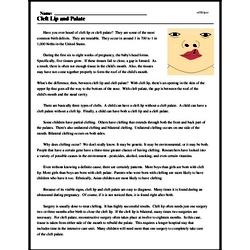
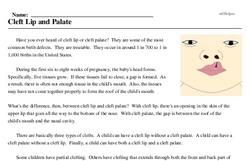
Cleft Lip and Palate
Reading Level
     edHelper's suggested reading level:   grades 4 to 6
     Flesch-Kincaid grade level:   6.62

Vocabulary
     challenging words:    aligned, defect, genetic, intensive, pregnancy, diagnose, long-term, successful, highly, opening, properly, social, ultrasound, environment, knowing, unit
     content words:    United States


Print Cleft Lip and Palate
edHelper.com subscriber options:
     Print Cleft Lip and Palate  (font options, pick words for additional puzzles, and more)

     Quickly print reading comprehension

     Print a proofreading activity


Feedback on Cleft Lip and Palate
     Leave your feedback on Cleft Lip and Palate  (use this link if you found an error in the story)


Cleft Lip and Palate
By Jennifer Kenny
  

1     Have you ever heard of cleft lip and cleft palate? They are some of the most common birth defects. They are treatable. They occur in around 1 in 700 to 1 in 1,000 births in the United States.
 
2     During the first six to eight weeks of pregnancy, the baby's head has formed. Specifically, five tissues grow. If these tissues fail to meet, a gap appears. As a result, there is often not enough tissue in the child's mouth. Also, the tissues may have not come together properly to form the roof of the child's mouth.
 
3     What's the difference, then, between cleft lip and cleft palate? With cleft lip, there's an opening in the skin of the upper lip that goes all the way to the bottom of the nose. With cleft palate, the gap is between the roof of the child's mouth and the nasal cavity.
 
4     There are basically three types of clefts. A child can have a cleft lip without a cleft palate. A child can have a cleft palate without a cleft lip. Finally, a child can have both a cleft lip and a cleft palate.
 
5     Some children experience partial clefting. Others extend through both the front and back part of the palates. There's also unilateral clefting and bilateral clefting. Unilateral clefting occurs on one side of the mouth; bilateral clefting occurs on both sides.

Paragraphs 6 to 12:
For the complete story with questions: click here for printable


Copyright © 2008 edHelper