edHelper.com
Children in History


Eliza Lucas


Eliza Lucas
Reading Level
     edHelper's suggested reading level:   grades 6 to 8
     Flesch-Kincaid grade level:   7.15

Vocabulary
     challenging words:    economic, teens, textile, military, solution, better, decorative, successful, death, seldom, economy, officer, responsible, health, laundry, generally
     content words:    Eliza Lucas, British Army, When Lieutenant Colonel Lucas, South Carolina, Lieutenant Colonel Lucas, Using Eliza Lucas, American Revolution, George Lucas, Eliza Lucas Pinckney, South Carolina Business Hall


Print Eliza Lucas
edHelper.com subscriber options:
     Print Eliza Lucas  (font options, pick words for additional puzzles, and more)

     Quickly print reading comprehension

     Print a proofreading activity


Feedback on Eliza Lucas
     Leave your feedback on Eliza Lucas  (use this link if you found an error in the story)


Eliza Lucas
By Jane Runyon
  

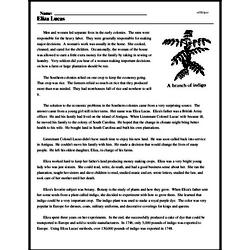
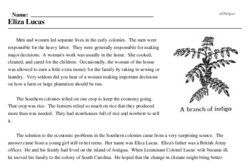
1     Men and women led separate lives in the early colonies. The men were responsible for the heavy labor. They were generally responsible for making major decisions. A woman's work was usually in the home. She cooked, cleaned, and cared for the children. Occasionally, the woman of the house was allowed to earn a little extra money for the family by taking in sewing or laundry. Very seldom did you hear of a woman making important decisions on how a farm or large plantation should be run.
 
2     The Southern colonies relied on one crop to keep the economy going. That crop was rice. The farmers relied so much on rice that they produced more than was needed. They had storehouses full of rice and nowhere to sell it.
 
3     The solution to the economic problems in the Southern colonies came from a very surprising source. The answer came from a young girl still in her teens. Her name was Eliza Lucas. Eliza's father was a British Army officer. He and his family had lived on the island of Antigua. When Lieutenant Colonel Lucas' wife became ill, he moved his family to the colony of South Carolina. He hoped that the change in climate might bring better health to his wife. He bought land in South Carolina and built his own plantations.

Paragraphs 4 to 10:
For the complete story with questions: click here for printable


Copyright © 2008 edHelper