edHelper.com
How Do Guide Dogs Do Their Job?


How Do Guide Dogs Do Their Job?
Reading Level
     edHelper's suggested reading level:   grades 6 to 8
     Flesch-Kincaid grade level:   5.42

Vocabulary
     challenging words:    companionship, command, assist, crossing, impairments, visually, disobedience, assistance, route, mobile, construction, disobey, lead, health, proceed, danger
     content words:    Guide Dogs


Print How Do Guide Dogs Do Their Job?
     Print How Do Guide Dogs Do Their Job?  (font options, pick words for additional puzzles, and more)


Quickly Print - PDF format
     Quickly Print: PDF (2 columns per page)

     Quickly Print: PDF (full page)


Quickly Print - HTML format
     Quickly Print: HTML


Proofreading Activity
     Print a proofreading activity


Feedback on How Do Guide Dogs Do Their Job?
     Leave your feedback on How Do Guide Dogs Do Their Job?  (use this link if you found an error in the story)


How Do Guide Dogs Do Their Job?
By Sharon Fabian
  

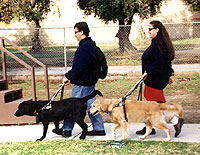
1     Guide dogs assist blind people and people with visual impairments as they travel on foot. The dogs' assistance helps their handlers become more mobile and more independent.
 
2     The job of a guide dog is not an easy one and not just any dog can qualify for the job. Golden retrievers, Labradors, and German shepherds are often used as guide dogs, but dogs of other breeds may also be used. To be a good guide dog, a dog must have certain traits. It must be intelligent, be able to concentrate for a long time, have a good memory, and be in good health.
 
3     Dogs begin preparing to become a guide dog when they are just puppies. Future guide dogs are raised by loving families known as puppy raisers. Puppy raisers, often families with children, take in a puppy at about the age of eight weeks. They raise the puppy until it is about one and one-half years old.
 
4     Puppy raisers take good care of the puppies to be sure that they grow up healthy. They teach the puppies to obey simple commands. They also train the puppies to be comfortable in many surroundings.
 
5     The puppies are taught how to walk on a leash. They are taught to sit and stay and to obey other basic commands.
 
6     It is important for the puppy raisers to take the puppies out often. They must get them used to as many places as possible so that the puppies will be able to safely guide their future handlers wherever they need to go. Puppy raisers take the dogs on outings several times a week. They go to malls, construction sites, busy streets, and restaurants.
 
7     They take them where they can be around other dogs and other people.
 
8     When the puppies reach the age of about one and one-half years, they are ready to begin their guide dog training. At this time, they are returned to an organization such as Guide Dogs for the Blind. Although the puppy raisers are sad to give them up, they know that the puppies are leaving to do important work.
 
9     At Guide Dogs for the Blind or another organization, trainers teach the specific skills that the dogs will need to safely guide a blind person through busy streets. They learn to walk in a straight line to the left and just in front of their handler. They learn to stay on their route and ignore distractions such as cats and squirrels. They learn to walk at a steady pace. They learn new commands: left, right, stop, and forward.

Paragraphs 10 to 16:
For the complete story with questions: click here for printable


Copyright © 2009 edHelper