edHelper.com
How Do Search and Rescue Dogs Do Their Jobs?


How Do Search and Rescue Dogs Do Their Jobs?
Reading Level
     edHelper's suggested reading level:   grades 6 to 8
     Flesch-Kincaid grade level:   6.52

Vocabulary
     challenging words:    gruesome, survival, extensive, better, valuable, communication, trapped, murder, avalanche, mutts, provides, caption, receive, soil, bond, disaster
     content words:    World Trade Center, Hurricane Katrina, Most SAR


Print How Do Search and Rescue Dogs Do Their Jobs?
     Print How Do Search and Rescue Dogs Do Their Jobs?  (font options, pick words for additional puzzles, and more)


Quickly Print - PDF format
     Quickly Print: PDF (2 columns per page)

     Quickly Print: PDF (full page)


Quickly Print - HTML format
     Quickly Print: HTML


Proofreading Activity
     Print a proofreading activity


Feedback on How Do Search and Rescue Dogs Do Their Jobs?
     Leave your feedback on How Do Search and Rescue Dogs Do Their Jobs?  (use this link if you found an error in the story)


How Do Search and Rescue Dogs Do Their Jobs?
By Sharon Fabian
  

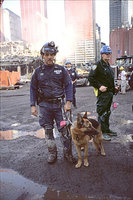
1     Caption: This is a picture of a canine rescue team on September 11, 2001 at the World Trade Center disaster.
 
2     The job of search and rescue dogs, or SAR dogs, is to find people. They do this using their sense of smell, which is many, many times better than any human's. SAR dogs do their job better than people ever could.
 
3     Dogs are not born great rescue dogs. They must be carefully trained, and their handlers must be trained, too. It is a long process with lots of practice that starts when the dog is just a puppy.
 
4     Many types of large, strong dogs can be trained to be SAR dogs including German shepherds, Dobermans, golden retrievers, bloodhounds, and mutts.
 
5     There are several types of SAR dogs, each with its own particular skills. There are air scent dogs, trailing dogs, water scent dogs, cadaver dogs, and avalanche dogs. Each one provides a very valuable service.

Paragraphs 6 to 14:
For the complete story with questions: click here for printable


Copyright © 2009 edHelper