edHelper.com
Rocks and Minerals


Other Ways of Determining Age


Other Ways of Determining Age
Reading Level
     edHelper's suggested reading level:   high interest, readability grades 6 to 8
     Flesch-Kincaid grade level:   6

Vocabulary
     challenging words:    igneous, sedimentary, intrusion, magma, elsewhere, lava, itself, harden, layer, cause, evidence, geologists, difficult, apply, history, believe


Print Other Ways of Determining Age
edHelper.com subscriber options:
     Print Other Ways of Determining Age  (font options, pick words for additional puzzles, and more)

     Quickly print reading comprehension

     Print a proofreading activity


Feedback on Other Ways of Determining Age
     Leave your feedback on Other Ways of Determining Age  (use this link if you found an error in the story)


Other Ways of Determining Age
By Patti Hutchison
  

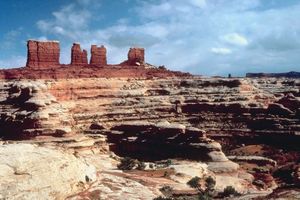
1     Uplifting, tilting, folding, and faulting. Sedimentary rock layers are often disturbed by forces within the Earth. This makes them difficult to study. The law of superposition does not always apply. How do scientists determine age under these circumstances? There are many methods.
 
2     Older layers of rock are often exposed at the Earth's surface. They are weathered and eroded. New sediments are deposited on top. They harden to form new sedimentary rock layers. This is an example of an unconformity.
 
3     Unconformities cause a gap in the ages of the rock layers above and below them. There is also a gap in the ages of the fossils these layers contain. This evidence tells scientists when and where changes have happened on the Earth's surface.
 
4     Scientists also study faults to help them know when changes in the Earth have occurred. A fault is a crack in a rock. Movement can take place at a fault. Rock layers on one side may shift up or down from the rock layers on the other side.

Paragraphs 5 to 11:
For the complete story with questions: click here for printable


Copyright © 2008 edHelper