edHelper.com
Black History and Blacks in U.S. History
Children in History
Phillis Wheatley - Childhood of a Poet


Phillis Wheatley - Childhood of a Poet
Reading Level
     edHelper's suggested reading level:   grades 5 to 7
     Flesch-Kincaid grade level:   6.25

Vocabulary
     challenging words:    translation, teaching, influential, writing, inspiration, loyalist, poetry, reading, colonist, possibly, better, incident, dedication, immediately, works, education
     content words:    Phillis Wheatley, North America, Susannah Wheatley, Boston Massacre, Crispus Attucks, George Whitefield, Salina Hastings, Lady Huntington, Atlantic Ocean


Print Phillis Wheatley - Childhood of a Poet
     Print Phillis Wheatley - Childhood of a Poet  (font options, pick words for additional puzzles, and more)


Quickly Print - PDF format
     Quickly Print: PDF (2 columns per page)

     Quickly Print: PDF (full page)


Quickly Print - HTML format
     Quickly Print: HTML


Proofreading Activity
     Print a proofreading activity


Feedback on Phillis Wheatley - Childhood of a Poet
     Leave your feedback on Phillis Wheatley - Childhood of a Poet  (use this link if you found an error in the story)


Phillis Wheatley - Childhood of a Poet
By Jane Runyon
  

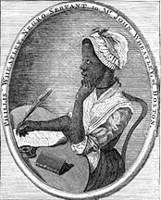
1     As far as anyone can tell, Phillis Wheatley was born in 1754. No one is quite sure of the exact date. There are no birth records that anyone can check. You see, Phillis was kidnapped from her home in Africa. She didn't remember much about her early life. She thought she must have been around seven years of age when she was put on a slave ship headed to America.
 
2     The ship Phillis was placed on was very small. There were perhaps seventy or eighty other young African women shoved into the same small space. The conditions on board the ship caused her to become ill. The food was bad, and the women were treated very badly. They lived in filth. They got very little clean air or sunlight. The rats on board the ship had a better life than the women did.
 
3     The trip from Africa to the colonies of North America was known as the middle passage of the triangular trade route. Ships would take goods to Africa from Europe. They would sell their goods and purchase slaves that were sold in the colonies. The money earned was used to purchase molasses for rum in the islands of the Caribbean. Then the ships would sail back to Europe and sell the molasses.
 
4     Phillis was put on the auction block as soon as she arrived in Boston. She was ill. She had no shoes. She had very little clothing left to cover her body. A kindly lady named Susannah Wheatley took pity on the poor child. She had come to the auction to purchase a slave who would be able to care for her now that her children were grown and her own health was poor.

Paragraphs 5 to 12:
For the complete story with questions: click here for printable


Copyright © 2009 edHelper