edHelper.com
How Do Windmills Produce Energy?


How Do Windmills Produce Energy?
Reading Level
     edHelper's suggested reading level:   grades 6 to 8
     Flesch-Kincaid grade level:   8.38

Vocabulary
     challenging words:    built-in, further, utility, windmill, transmission, turbine, wingspan, daytime, reverse, consumer, maximum, production, generator, absorb, consideration, design
     content words:    North Sea, Hans Hillewaert, Mediterranean Sea, United States, Wind Power Density


Print How Do Windmills Produce Energy?
     Print How Do Windmills Produce Energy?  (font options, pick words for additional puzzles, and more)


Quickly Print - PDF format
     Quickly Print: PDF (2 columns per page)

     Quickly Print: PDF (full page)


Quickly Print - HTML format
     Quickly Print: HTML


Proofreading Activity
     Print a proofreading activity


Feedback on How Do Windmills Produce Energy?
     Leave your feedback on How Do Windmills Produce Energy?  (use this link if you found an error in the story)


How Do Windmills Produce Energy?
By Sharon Fabian
  

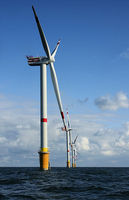
1     Caption: A windfarm in the North Sea off the coast of Belgium. Photo by Hans Hillewaert (Lycaon)

 
2     People have used wind energy since ancient times. Thousands of years ago, wind powered sailing ships across the Mediterranean Sea. Hundreds of years ago in Holland, windmills were used to pump water. In the early days of our country, colonists used windmills to grind wheat and corn. But it has only been since the energy crisis of the 1970s that people have really taken an interest in using windmills as a source of electric power.
 
3     Windmills only provide a small percentage of our power, but their use is growing. Windmill farms with rows and rows of giant windmills can be seen in states all across the United States, as well as in countries all around the world.
 
4     Since windmills only operate when the wind is blowing, the most important consideration in setting up a windmill is deciding where to locate it. Maps that show measurements of Wind Power Density (WPD) are available to help. These maps use color-coding to show how the WPD varies area by area. Tops of rounded hills, open plains, and shorelines are all good locations because they often have high WPD.

Paragraphs 5 to 12:
For the complete story with questions: click here for printable


Copyright © 2009 edHelper