edHelper.com
How Does a TV Work?


How Does a TV Work?
Reading Level
     edHelper's suggested reading level:   grades 5 to 8
     Flesch-Kincaid grade level:   5.73

Vocabulary
     challenging words:    recorder, transmit, recording, resent, scanner, receiver, satellite, broadcast, electromagnetic, replay, circuit, towers, strengthen, select, record, works
     content words:    When TV, Cable TV


Print How Does a TV Work?
     Print How Does a TV Work?  (font options, pick words for additional puzzles, and more)


Quickly Print - PDF format
     Quickly Print: PDF (2 columns per page)

     Quickly Print: PDF (full page)


Quickly Print - HTML format
     Quickly Print: HTML


Proofreading Activity
     Print a proofreading activity


Feedback on How Does a TV Work?
     Leave your feedback on How Does a TV Work?  (use this link if you found an error in the story)


How Does a TV Work?
By Cindy Grigg
  

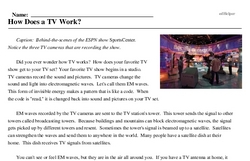
1     Caption: Behind-the-scenes of the ESPN show SportsCenter. Notice the three TV cameras that are recording the show.
 
2     Did you ever wonder how TV works? How does your favorite TV show get to your TV set? Your favorite TV show begins in a studio. TV cameras record the sound and pictures. TV cameras change the sound and light into electromagnetic waves. Let's call them EM waves. This form of invisible energy makes a pattern that is like a code. When the code is "read," it is changed back into sound and pictures on your TV set.
 
3     EM waves recorded by the TV cameras are sent to the TV station's tower. This tower sends the signal to other towers called broadcasting towers. Because buildings and mountains can block electromagnetic waves, the signal gets picked up by different towers and resent. Sometimes the tower's signal is beamed up to a satellite. Satellites can strengthen the waves and send them to anywhere in the world. Many people have a satellite dish at their home. This dish receives TV signals from satellites.

Paragraphs 4 to 10:
For the complete story with questions: click here for printable


Copyright © 2009 edHelper