edHelper.com
Lemmings


Lemmings

A Short Reader

Reading Level
     edHelper's suggested reading level:   grades 5 to 6
     Flesch-Kincaid grade level:   5.45

Vocabulary
     challenging words:    genetic, disappearance, multiply, tundra, unique, ounce, during, whatever, breed, however, increase, become, number, reason, northern, average


Print Lemmings
     Print Lemmings  (font options, pick words for additional puzzles, and more)


Quickly Print - PDF format
     Quickly Print: PDF (2 columns per page)

     Quickly Print: PDF (full page)


Quickly Print - HTML format
     Quickly Print: HTML


Proofreading Activity
     Print a proofreading activity


Feedback on Lemmings
     Leave your feedback on Lemmings  (use this link if you found an error in the story)


Lemmings
By Sheri Skelton
  

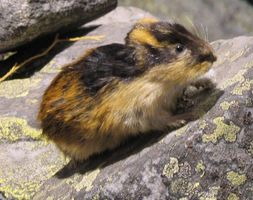
1     Lemmings are chubby little rodents. They live in arctic areas on the tundra. They have furry bodies and short tails. Lemmings don't hibernate during the cold winters. They dig burrows in the snow. The burrows help lemmings stay warm. The burrows also help lemmings hide from predators. Many animals like to eat lemmings. These include owls, weasels, wolves, arctic foxes, and wolverines.
 
2     Alaska is the home for one true lemming and two other lemmings that aren't true lemmings. The brown lemming is a true lemming. It is the largest lemming. It is four to five inches long with a one-inch tail. Its average weight is three ounces. The brown lemming eats grass during the summer. In the winter the brown lemming eats willow bark and twigs. Brown lemmings might become cannibals and eat other lemmings if food is hard to find.
 
3     The collared lemming is not a true lemming. It is a rodent, however, and a unique one. Its fur turns completely white in the winter. Eskimos use the thick white fur to trim their clothing. The collared lemming also grows sharp claws on several toes on its front feet during the winter. The lemming uses the claws to dig into hard snow. By the time the snow melts, the sharp claws have been worn away and look normal.

Paragraphs 4 to 5:
For the complete story with questions: click here for printable


Copyright © 2009 edHelper