edHelper.com
Sports


Taking Aim at Skeet


Taking Aim at Skeet
Reading Level
     edHelper's suggested reading level:   grades 4 to 6
     Flesch-Kincaid grade level:   5.76

Vocabulary
     challenging words:    barred, controversy, finest, repeated, successful, launched, disks, pigeon, shots, equally, costly, gunpowder, launch, order, match, ability
     content words:    William Foster, Gertrude Hurlbutt, Olympic Games, Olympic Skeet


Print Taking Aim at Skeet
edHelper.com subscriber options:
     Print Taking Aim at Skeet  (font options, pick words for additional puzzles, and more)

     Quickly print reading comprehension

     Print a proofreading activity


Feedback on Taking Aim at Skeet
     Leave your feedback on Taking Aim at Skeet  (use this link if you found an error in the story)


Taking Aim at Skeet
By Jane Runyon
  

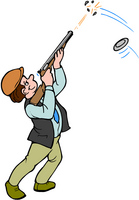
1     Humans have hunted for thousands of years. The invention of gunpowder and weapons made it easier for hunters to kill their prey. In order to be a good hunter, it takes practice. Just like you have to practice to shoot a basketball, you have to practice to shoot a gun correctly. It was just this type of practice that led to the creation of the sport known today as skeet.
 
2     In the early 1920's, some hunters preferred to shoot birds. Birds are difficult to shoot because of their ability to fly away at the first hint of danger. Bird hunters needed to practice shooting at a moving object. Some hunters chose to capture pigeons. They would release the pigeons into the air one at a time and practice their shot. It was time consuming and costly to keep a supply of pigeons ready for their practice sessions. They also were given a hard time by other people who thought it was inhumane to use live pigeons for target practice.
 
3     C.E. Davies, his son, Henry, and a friend, William Foster, liked to practice their shooting at Davies' kennels in Andover, Massachusetts. They decided to replace real pigeons with disks made of clay. Someone would throw the clay disks into the air while the hunters shot at them. Since these disks were taking the place of real pigeons, the men called them "clay pigeons."

Paragraphs 4 to 9:
For the complete story with questions: click here for printable


Copyright © 2008 edHelper