edHelper.com
Rocks and Minerals


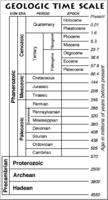
Marking Time Geologically


Marking Time Geologically
Reading Level
     edHelper's suggested reading level:   high interest, readability grades 6 to 8
     Flesch-Kincaid grade level:   6.16

Vocabulary
     challenging words:    further, tectonic, erosion, microscope, absolute, atmosphere, billion, extinction, principle, geologic, division, mass, outline, lasted, present, layer
     content words:    Hadean Eon, Archaen Eon, Proterozoic Era, Phanerozoic Eon


Print Marking Time Geologically
edHelper.com subscriber options:
     Print Marking Time Geologically  (font options, pick words for additional puzzles, and more)

     Quickly print reading comprehension

     Print a proofreading activity


Feedback on Marking Time Geologically
     Leave your feedback on Marking Time Geologically  (use this link if you found an error in the story)


Marking Time Geologically
By Patti Hutchison
  

1     Rocks can tell us amazing stories about the history of the earth. Over millions of years, the earth has undergone many changes. There have been volcanic eruptions, tectonic collisions, and ice ages. Many species of plants and animals have come and gone. By studying fossils and rock layers, scientists have put together a kind of photo album of earth's history.
 
2     Geologists have divided the history of the earth into units of time. They call it the geologic time scale. This record of time begins 4.6 billion years ago when the earth was formed. It continues until present day. These time units are based on the fossils that are contained in the layers of rock. This is sometimes called the fossil record. The units are also based on major events that took place such as asteroid impacts or mass extinctions.
 
3     Imagine the geological time scale as a vertical time line. The oldest division of time is at the bottom. As you move upward, each division is younger. This relates to the younger layers of rock.
 
4     Some scientists believe that sediments have been laid down in order. Each layer represents a slice of time. This is called the principle of superposition. This principle is sometimes difficult to apply when studying the rock layers. This is because the rocks have been disturbed by erosion and tectonic forces. However, scientists have found enough evidence to put together the time scale.
 
5     An eon is the longest time period. It is measured in billions of years. Eons are divided into eras. Eras are measured in tens to hundreds of millions of years. Divisions within eras are called periods. There are two to seven periods per era. Most lasted thirty to eighty million years. Periods are broken down into epochs.

Paragraphs 6 to 11:
For the complete story with questions: click here for printable


Copyright © 2008 edHelper