edHelper.com
A Brief History of Cattle Brands


A Brief History of Cattle Brands
Reading Level
     edHelper's suggested reading level:   grades 5 to 7
     Flesch-Kincaid grade level:   6.57

Vocabulary
     challenging words:    ornate, historical, ownership, dated, heated, slash, identify, practice, purpose, properly, ensure, history, early, although, such, certain
     content words:    Ancient Egyptian, Ancient Greeks, Hernando Cortez, New World, Navajo Nation, New Mexico, Cattle Ranch, North Dakota, Reynolds Brothers, Visitor Center


Print A Brief History of Cattle Brands
     Print A Brief History of Cattle Brands  (font options, pick words for additional puzzles, and more)


Quickly Print - PDF format
     Quickly Print: PDF (2 columns per page)

     Quickly Print: PDF (full page)


Quickly Print - HTML format
     Quickly Print: HTML


Proofreading Activity
     Print a proofreading activity


Feedback on A Brief History of Cattle Brands
     Leave your feedback on A Brief History of Cattle Brands  (use this link if you found an error in the story)


A Brief History of Cattle Brands
By Joyce Furstenau
  

1     The practice of branding can be dated back to 2700 B.C. Ancient Egyptian tombs show branding of oxen with hieroglyphics. Both the Ancient Greeks and Romans branded their cattle with a hot iron. They also marked their slaves the same way. (OUCH!) Hernando Cortez brought cattle stamped with his mark of three crosses to the New World from Spain in 1541.
 
2     The purpose of cattle branding is to be a visible and permanent mark of ownership. It is used to prevent theft and to identify the owner of a lost animal. It can also provide anyone with the animal's history. Today, brands are registered with a state's brand inspector. Each time an animal is sold, the new owner should get a bill of sale as proof of ownership.
 
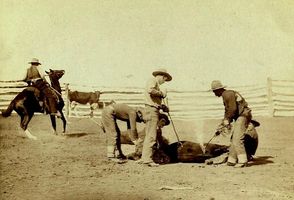
3     Brands are made with the use of an iron that is heated over an open fire. A specific procedure is used to ensure that the branding is safely and properly done. Cattle are usually branded on the hips or ribs, while horses are branded on the hip or shoulder. Many brands are registered. A registered brand always takes precedence over a non-registered brand.

Paragraphs 4 to 7:
For the complete story with questions: click here for printable


Copyright © 2009 edHelper