edHelper.com
Making Maple Syrup


Making Maple Syrup
Reading Level
     edHelper's suggested reading level:   grades 6 to 8
     Flesch-Kincaid grade level:   8.63

Vocabulary
     challenging words:    earthenware, further, technological, producer, dripping, concave, better, heated, mouth-watering, leading, directly, commonly, primitive, during, shack, vacuum
     content words:    United States, Native Americans, New York


Print Making Maple Syrup
     Print Making Maple Syrup  (font options, pick words for additional puzzles, and more)


Quickly Print - PDF format
     Quickly Print: PDF (2 columns per page)

     Quickly Print: PDF (full page)


Quickly Print - HTML format
     Quickly Print: HTML


Proofreading Activity
     Print a proofreading activity


Feedback on Making Maple Syrup
     Leave your feedback on Making Maple Syrup  (use this link if you found an error in the story)


Making Maple Syrup
By Joyce Furstenau
  

1     The aroma of pancakes sizzling on the griddle can be a scent from heaven, UNLESS, as you sit down for your first mouth-watering bite, you realize you're out of maple syrup. Other toppings can make those pancakes melt in your mouth, but maple syrup tops the list.
 
2     Where does most of America's maple syrup come from? The short answer would be "Vermont." Actually, Quebec, Canada, produces by far the most maple syrup worldwide, but the leading producer in the United States is the state of Vermont. In 2009, the state of Vermont produced 920,000 gallons of maple syrup. The syrup used for this tasty treat comes from the collected sap of sugar maple trees.
 
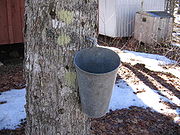
3     When the early colonists landed in America, Native Americans took the colonists under their wing and showed them such things as how to plant corn and how to make maple syrup. The natives used the sap as a source of energy, much like honey. They used primitive stone tools to carve V shapes into the sugar maple trees during late winter. They used concave pieces of bark or sturdy reeds to collect the dripping sap in birch bark buckets. The sap was heated and condensed by dropping hot stones into the sap. The natives also boiled the sap over an open fire in earthenware pots.

Paragraphs 4 to 7:
For the complete story with questions: click here for printable


Copyright © 2009 edHelper