edHelper.com
Clues to Earth's Past


Clues to Earth's Past
Reading Level
     edHelper's suggested reading level:   grades 6 to 8
     Flesch-Kincaid grade level:   6.47

Vocabulary
     challenging words:    jigsaw, continental, finding, trapped, prove, theory, landmass, meaning, widely, evidence, likely, during, compare, traveled, between, believe
     content words:    Alfred Wegener, South America, Atlantic Ocean, South Africa, Cape Mountains, Buenos Aires, Harry Hess


Print Clues to Earth's Past
     Print Clues to Earth's Past  (font options, pick words for additional puzzles, and more)


Quickly Print - PDF format
     Quickly Print: PDF (2 columns per page)

     Quickly Print: PDF (full page)


Quickly Print - HTML format
     Quickly Print: HTML


Proofreading Activity
     Print a proofreading activity


Feedback on Clues to Earth's Past
     Leave your feedback on Clues to Earth's Past  (use this link if you found an error in the story)


Clues to Earth's Past
By Cindy Grigg
  

1     How do scientists know what the Earth was like long ago? Scientists ask questions. They notice things. They gather clues and evidence. Then they make a hypothesis. They try to collect information to prove whether their hypothesis is correct or not.
 
2     In 1915, Alfred Wegener published his theory of continental drift. He said that all of Earth's continents were drifting. He thought that they could fit together. He carefully studied the outlines of the continents. He noticed that Africa and South America looked as though they would fit together like a jigsaw puzzle. He compared rock types from both sides of the Atlantic Ocean. He looked at fossils in the rock and found similar ones. How did the rocks and fossils get separated by the Atlantic Ocean?
 
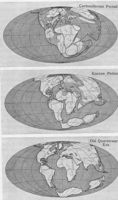
3     Wegener believed that all of Earth's land masses were once joined into one giant landmass. He called it Pangaea, meaning "All Earth." Then, he said, Pangaea split apart. The different continents drifted away from each other, in time finding their modern places.

Paragraphs 4 to 8:
For the complete story with questions: click here for printable


Copyright © 2009 edHelper