edHelper.com
The Civil War
(1861-1865)


Civil War Prisons


Civil War Prisons
Reading Level
     edHelper's suggested reading level:   high interest, readability grades 4 to 6
     Flesch-Kincaid grade level:   5.27

Vocabulary
     challenging words:    notorious, brutal, commander, medical, wounded, grounds, rate, death, scurvy, battle, cruel, soldier, often, treatment, dangerous, early
     content words:    In February, By July, Andersonville Prison, Captain Heinrich, New York, Elmira Prison, Benjamin Tracy, Edwin Stanton, In August, Woodlawn National Cemetery


Print Civil War Prisons
edHelper.com subscriber options:
     Print Civil War Prisons  (font options, pick words for additional puzzles, and more)

     Quickly print reading comprehension

     Print a proofreading activity


Feedback on Civil War Prisons
     Leave your feedback on Civil War Prisons  (use this link if you found an error in the story)


Civil War Prisons
By Cathy Pearl
  

1     When the war first started, prisoners were exchanged on the battlefield after the fighting was over. Not long into the war, this practice started to fall apart. Instead, the North and the South started to build prisons to hold the men that were captured during a battle. Some of the prisons were okay. Others were more dangerous than the battles that the men were fighting in.
 
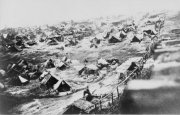
2     One of the most notorious prisons was called Andersonville. This prison was in southwest Georgia. It was started in early 1864. In February, Union soldiers were moved to the prison even though it wasn't done yet.
 
3     When it was first built, the prison was about sixteen acres. It was surrounded by a fifteen-foot tall stockade made of logs. It was built to hold ten thousand men. The prison was enlarged to twenty-six acres later in the war. It was still overcrowded. By July of 1864, there were more than thirty thousand men at Andersonville Prison.
 
4     The conditions at the prison were horrible. The men were not allowed to build shelter for themselves. Some managed to make tents out of old clothes and blankets, but this did not protect them from the weather. There was no medical treatment for sick or wounded soldiers. As many as one hundred men died each day during the summer.

Paragraphs 5 to 14:
For the complete story with questions: click here for printable


Copyright © 2008 edHelper