edHelper.com
Canadian Theme Unit
Prince Edward Island and Confederation


Prince Edward Island and Confederation
Reading Level
     edHelper's suggested reading level:   grades 6 to 7
     Flesch-Kincaid grade level:   7.08

Vocabulary
     challenging words:    rents, rethink, reciprocity, economic, treaty, union, refused, federal, parliament, presented, better, imaginable, photograph, insure, province, economy
     content words:    Government House, After Manitoba, Prince Edward Island, Edward Island, Jacques Cartier, Captain Samuel Holland, Charlottetown Conference, Quebec Conference, In May, Since Prince Edward Island


Print Prince Edward Island and Confederation
     Print Prince Edward Island and Confederation  (font options, pick words for additional puzzles, and more)


Quickly Print - PDF format
     Quickly Print: PDF (2 columns per page)

     Quickly Print: PDF (full page)


Quickly Print - HTML format
     Quickly Print: HTML


Proofreading Activity
     Print a proofreading activity


Feedback on Prince Edward Island and Confederation
     Leave your feedback on Prince Edward Island and Confederation  (use this link if you found an error in the story)


Prince Edward Island and Confederation
By Mary Lynn Bushong
  

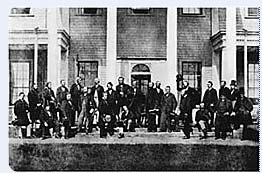
1     Caption: Official photograph of the Fathers of Confederation at Government House
 
2     When Canada began expanding West, attention was diverted from what would be her smallest province. After Manitoba joined confederation in 1870, Prince Edward Island rethought her decision not to join.
 
3     Prince Edward Island, or P.E.I. as she is affectionately known, was originally the territory of the Micmac people. They called the island Abegweit [ah-BEG-wate] which meant "land cradled on the waves."
 
4     Jacques Cartier described the island as "the most beautiful stretch of land imaginable." Champlain named it St. John's Island in 1603. In 1763, it changed from French to English control. Then, in 1799, the name was changed to Prince Edward Island.
 
5     The people of P.E.I. were known for their independence. They wanted to be left alone to do things their way. They had a strong economy based on farming, fishing, shipbuilding, and the merchant trade.
 
6     In 1766, the land was divided by Captain Samuel Holland. The 67 lots he made were distributed to landowners in Britain. This was to cause a lot of trouble later, because the absentee landowners would not sell the land and charged high rents.
 
7     In 1864, the islanders held the Charlottetown Conference. It is interesting that the conference was held there since the P.E.I. delegates were against the union. Some think it was held there as a way to get the P.E.I. delegates to attend.
 
8     The reasons for their lack of interest were various. The main one was that some islanders thought they would lose control to their own government.
 
9     During the discussions several ideas were presented that made the delegates rethink their stance. The other colonies spoke of buying out the large landowners through the new federal government. This would get rid of the absentee landlords. Their holdings could be purchased and the land resold to the farmers working it. That would solve a major problem.

Paragraphs 10 to 18:
For the complete story with questions: click here for printable


Copyright © 2009 edHelper