edHelper.com
Renaissance


Education in the Renaissance


Education in the Renaissance
Reading Level
     edHelper's suggested reading level:   grades 6 to 8
     Flesch-Kincaid grade level:   8.71

Vocabulary
     challenging words:    apprenticeships, journeyman, liberal, nobility, experimentation, teaching, astronomy, reading, vocabulary, arithmetic, theology, newly, quill, pursue, schooling, public
     content words:    In Renaissance Europe


Print Education in the Renaissance
edHelper.com subscriber options:
     Print Education in the Renaissance  (font options, pick words for additional puzzles, and more)

     Quickly print reading comprehension

     Print a proofreading activity


Feedback on Education in the Renaissance
     Leave your feedback on Education in the Renaissance  (use this link if you found an error in the story)


Education in the Renaissance
By Sharon Fabian
  

1     The Renaissance was a time of learning, but it wasn't a time of schools as we know them today. Public schools for everyone were still a long way off. In Renaissance Europe, schooling was for those who could afford it. Some people were well educated, while others never attended school.
 
2     Education for Renaissance boys was of two sorts. There was classical education based on the Latin language for boys who planned to go on to a university. There was also education through apprenticeships for boys who planned to pursue a trade.
 
3     Girls received less education than boys during the Renaissance. Some girls did become well educated in the classics, and some also became apprentices. Many more were educated mainly in practical matters at home.
 
4     In England, boys who were being prepared for college began with petty school. This was the earliest school for very young boys, and it was often taught in the teacher's home. Soon, these boys progressed to grammar school where they learned Latin vocabulary and grammar. Classics of Latin literature were used as the texts for their lessons.
 
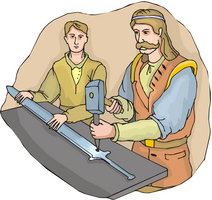
5     In grammar school, the boys were taught by a Latin master. The master instructed the boys from his raised desk. The boys at their benches took notes with their quill pens, keeping a record of sayings and vocabulary words that might be useful later on.

Paragraphs 6 to 13:
For the complete story with questions: click here for printable


Copyright © 2008 edHelper