edHelper.com
Weather


Glacier Movements and Effects on Climate


Glacier Movements and Effects on Climate
Reading Level
     edHelper's suggested reading level:   high interest, readability grades 4 to 6
     Flesch-Kincaid grade level:   4.18

Vocabulary
     challenging words:    bedrock, gunshot, retreat, extremely, gravity, peaceful, mass, rate, fairly, planes, fastest, affects, friction, level, history, trapped
     content words:    Glacier Bay, Ohio River Valley, North America, Polar Regions, South Poles


Print Glacier Movements and Effects on Climate
edHelper.com subscriber options:
     Print Glacier Movements and Effects on Climate  (font options, pick words for additional puzzles, and more)

     Quickly print reading comprehension

     Print a proofreading activity


Feedback on Glacier Movements and Effects on Climate
     Leave your feedback on Glacier Movements and Effects on Climate  (use this link if you found an error in the story)


Glacier Movements and Effects on Climate
By Patti Hutchison
  

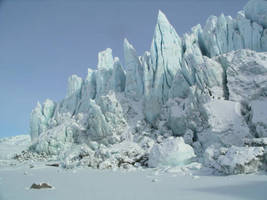
1     You are sailing on peaceful Glacier Bay in Alaska. Then, all of a sudden--BANG-- it sounds like a gunshot. Then-- SPLASH. A chunk of glacier the size of your boat falls into the water. Its wake rocks your boat. What an awesome sight! How do glaciers move, and how does their movement affect the climate?
 
2     When an ice age occurs, the climate is very cold. Glaciers advance. This happens when large amounts of snow build up on an ice field. The weight of the snow causes the pressure to build. The glacier is squeezed over the side of the ice field. Its size increases. During the last ice age, glaciers covered over 30 percent of the earth's surface. They advanced as far south as the Ohio River Valley in North America.
 
3     As the climate warms, glaciers retreat. The ice melts, and the size of the glacier shrinks. This is what is happening to the Polar Regions today. Glaciers only take up about ten percent of the earth's surface right now.

Paragraphs 4 to 10:
For the complete story with questions: click here for printable


Copyright © 2008 edHelper