edHelper.com
Economics


Government and Money


Government and Money
Reading Level
     edHelper's suggested reading level:   grades 6 to 12
     Flesch-Kincaid grade level:   6.14

Vocabulary
     challenging words:    fiscal, trillion, regional, deficit, inflation, unemployed, unemployment, lottery, rates, armed, multiply, inherit, bridges, value, commercial, investment
     content words:    Federal Reserve Banks, United States, Federal Reserve System


Print Government and Money
edHelper.com subscriber options:
     Print Government and Money  (font options, pick words for additional puzzles, and more)

     Quickly print reading comprehension

     Print a proofreading activity


Feedback on Government and Money
     Leave your feedback on Government and Money  (use this link if you found an error in the story)


Government and Money
By Cindy Grigg
  

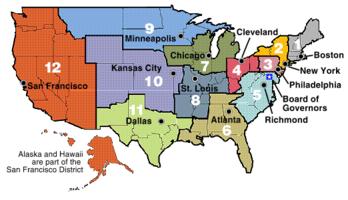
1     Caption: This is a map showing the districts of the twelve Federal Reserve Banks.
 
2     The United States is a big country. The American government spends a great deal of money to run the country. The Federal Reserve System is the government's bank. It is divided into twelve regional banks across the country, with its main headquarters in Washington, D.C. The "Fed," as it is commonly called, controls the amount of money in circulation. It holds a percentage of the deposits of commercial banks and lends money to them when they need it.
 
3     The Fed acts like a traffic cop. When the Fed sees there is too much traffic, or money in the economy, it slows the economy down. The Fed can require banks to put more money in reserve- that's money that cannot be loaned. Or the Fed can cause banks to raise the interest rates on loans to customers. The more interest the banks charge, the fewer the number of people who want to borrow money. People have less to spend, so the amount of money in circulation decreases.
 
4     When there is not enough money in circulation, the Fed allows banks to keep less money in reserve. The banks then have more money to lend and can lower their interest rates to encourage customers to borrow more money.
 
5     With more money in circulation, people spend more. Businesses expand and hire more people. But sometimes businesses can't produce all the things people want to buy. What happens? Prices may rise. On the other hand, if there isn't enough money in circulation, people won't spend very much. Businesses will not grow, and jobs will be harder to find. It's the Fed's job to keep spending in balance with the production of goods and services.

Paragraphs 6 to 12:
For the complete story with questions: click here for printable


Copyright © 2008 edHelper