edHelper.com
Illnesses


Impetigo


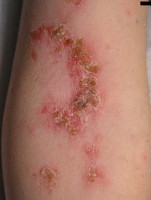
Impetigo
Reading Level
     edHelper's suggested reading level:   grades 5 to 7
     Flesch-Kincaid grade level:   8.21

Vocabulary
     challenging words:    antibacterial, topical, numerous, bloodstream, pose, tremendous, mainly, painless, commonly, acne, frequently, extremely, leads, abound, rarely, affected


Print Impetigo
edHelper.com subscriber options:
     Print Impetigo  (font options, pick words for additional puzzles, and more)

     Quickly print reading comprehension

     Print a proofreading activity


Feedback on Impetigo
     Leave your feedback on Impetigo  (use this link if you found an error in the story)


Impetigo
By Jennifer Kenny
  

1     Numerous skin conditions abound. People suffer from rashes, discolorations, bug bites, acne, and so on. Children are not immune to these things. For example, children often get one commonly occurring condition called impetigo.
 
2     Impetigo can appear on any person, young or old. However, it is a skin infection that mainly affects infants and children. In fact, it is one of the most common skin infections among children. It is very, very contagious, although it is rarely serious.
 
3     In general, impetigo is caused by bacteria and is known for its crusting skin lesions. It most often appears around the nose and mouth. The bacteria are often able to enter an area where the skin is broken, such as through a bug bite or cut, but it can develop on skin that doesn't appear to have any of these breaks. Scratching and touching the sores of impetigo will cause it to spread to other parts of the body and to other people.
 
4     There are three different kinds of impetigo: impetigo contagiosa, bullous impetigo, and ecthyma. Impetigo contagiosa is the most common kind. Usually, a red sore appears on the face. It ruptures rapidly and oozes pus. This creates a honey-colored crust. Gradually, it disappears without a scar. It may be itchy, but it is not normally painful. Some lymph nodes nearby may become swollen, but there's usually not a fever. That's the good news. The bad news is that it spreads easily and is very contagious to others. Bullous impetigo tends to affect the little ones, normally under two years old. The blisters with this kind of impetigo are typically painless also, but rather red and itchy. The blisters normally occur on the trunk, arms, and legs. When these blisters break and scab over, they often form a crust of yellow color. The blisters of bullous impetigo often last longer than the blisters of impetigo contagiosa. Finally, the third kind of impetigo, called ecthyma, can be more serious. The sores are painful, appear on the legs and feet, and often infect the dermis, the skin's second layer. The sores can turn into deep ulcers which scar.

Paragraphs 5 to 11:
For the complete story with questions: click here for printable


Copyright © 2008 edHelper