edHelper.com
Illnesses


Bell's Palsy


Bell's Palsy
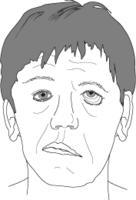
Reading Level
     edHelper's suggested reading level:   grades 5 to 7
     Flesch-Kincaid grade level:   6.36

Vocabulary
     challenging words:    mobility, rubella, swelling, gradual, original, life-threatening, pregnancy, antiviral, conduction, corticosteroids, cranial, diabetics, herpes, recur, sinus, viral
     content words:    Sir Charles Bell


Print Bell's Palsy
edHelper.com subscriber options:
     Print Bell's Palsy  (font options, pick words for additional puzzles, and more)

     Quickly print reading comprehension

     Print a proofreading activity


Feedback on Bell's Palsy
     Leave your feedback on Bell's Palsy  (use this link if you found an error in the story)


Bell's Palsy
By Jennifer Kenny
  

1     Can you imagine going to bed one night and being fine, just to wake up with half of your face paralyzed? It sounds like something out of a medical TV drama, but for some people it's real life. It happens more than you might think. It's a condition called Bell's palsy.
 
2     What exactly is Bell's palsy? It is an acute case of cranial mononeuropathy VII, which is a fancy way of saying it's a disorder involving a single nerve - cranial nerve VII. The 7th cranial, or facial, nerve is the nerve that controls the movement of the face muscles. As a result of this condition, the facial muscles weaken or become paralyzed.
 
3     How did Bell's palsy get its name? Sir Charles Bell was a Scottish surgeon around two hundred years ago. He specifically studied this nerve and so the condition is named for him.
 
4     What are the signs and symptoms of Bell's palsy? Most people wake up and find the symptoms are just there. Others have a strange sensation in the morning, such as a dry eye, and then the rest of the symptoms appear as the day goes on. Obviously then the progression of symptoms is quick. In general, the face may be paralyzed on one side. The face feels stiff and pulled to one side. The eye on the affected side might have trouble closing; therefore it may be very dry, too. Some people complain of a lack of tears; some complain of excessive tearing. There's often sensitivity to light. The condition causes problem with facial movement. As a result, drooling may occur. The face will droop. Facial expressions will be difficult. There will also be difficulty eating and drinking. Taste may be distorted. People report a sensitivity to sound, pain in or near the ear, and sometimes headaches. Some people complain of a runny nose; some people complain of a stuffy nose.

Paragraphs 5 to 11:
For the complete story with questions: click here for printable


Copyright © 2008 edHelper