edHelper.com
Energy


Energy from Water


Energy from Water
Reading Level
     edHelper's suggested reading level:   high interest, readability grades 6 to 9
     Flesch-Kincaid grade level:   7.33

Vocabulary
     challenging words:    kinetic, inexpensive, internal, tidal, surrounding, disrupt, currently, hydroelectric, reservoir, estimate, geothermal, natural, environment, generator, power, demand
     content words:    Niagara Falls, New York


Print Energy from Water
edHelper.com subscriber options:
     Print Energy from Water  (font options, pick words for additional puzzles, and more)

     Quickly print reading comprehension

     Print a proofreading activity


Feedback on Energy from Water
     Leave your feedback on Energy from Water  (use this link if you found an error in the story)


Energy from Water
By Patti Hutchison
  

1     Do you know that over 150,000 gallons of water flow over Niagara Falls every second? This movement releases a great amount of energy. It is used to produce electricity. How does this work?
 
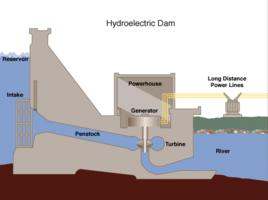
2     At night, half the water flowing toward the brink of the falls is detoured into a tunnel system. The water flows over huge turbines. The motion of the water turns the turbines. This converts the kinetic energy of moving water to mechanical energy. It drives a generator that produces electricity. There is enough electricity made to power western New York and parts of Canada.
 
3     Electricity that is generated from flowing water is called hydroelectric power. The Niagara is not the only river that produces this kind of power. Dams are built across rivers. Behind the dam is a reservoir. The water flows through large pipes. It turns the turbines that produce electricity. About ten percent of the electricity used in the U.S. is hydroelectric power.
 
4     Power from water sources has many advantages. First, it does not pollute the environment. Dams provide drinking water to surrounding areas. They control flooding. They are places for swimming, boating, and fishing. Water power is inexpensive to produce and is a renewable source of energy.

Paragraphs 5 to 11:
For the complete story with questions: click here for printable


Copyright © 2008 edHelper