edHelper.com
The United States Grows
(1865-1900)

Children Go to Work


Children Go to Work
Reading Level
     edHelper's suggested reading level:   high interest, readability grades 3 to 5
     Flesch-Kincaid grade level:   4.39

Vocabulary
     challenging words:    punishment, education, mills, caption, fell, textile, working, however, impossible, daughter, amount, dangerous, jobs, meant, willing, okay
     content words:    Civil War, United States


Print Children Go to Work
     Print Children Go to Work  (font options, pick words for additional puzzles, and more)


Quickly Print - PDF format
     Quickly Print: PDF (2 columns per page)

     Quickly Print: PDF (full page)


Quickly Print - HTML format
     Quickly Print: HTML


Proofreading Activity
     Print a proofreading activity


Feedback on Children Go to Work
     Leave your feedback on Children Go to Work  (use this link if you found an error in the story)


Children Go to Work
By Cathy Pearl
  

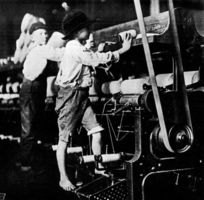
1     Caption: Children working in a textile mill barefooted.
 
2     After the Civil War, more factories were built in the United States. More factories meant that more people were needed to work in them. These people came from all over the country and all over the world. At the time, there were no laws about who was allowed to work in a factory. Many of the workers were small children.
 
3     Most of the workers were men who had left farms to come to work in the factories. The men thought that their families would have better lives in the cities. But the pay in factories was very low. It was impossible for one man who worked in a factory to make enough money to take care of his family. This meant that the rest of the family had to go to work, too.
 
4     Many children quit school and went to work when they were only twelve or thirteen years old. If a family member was hurt, the son or daughter had to go to work at an even younger age. Children as young as eight worked in factories. By the end of the 1800s, twenty percent of children from ten to sixteen were working.

Paragraphs 5 to 13:
For the complete story with questions: click here for printable


Copyright © 2009 edHelper