edHelper.com
Explorers


Telescopes Over Time


Telescopes Over Time
Reading Level
     edHelper's suggested reading level:   grades 6 to 7
     Flesch-Kincaid grade level:   7.51

Vocabulary
     challenging words:    convex, focal, avid, radiation, launched, optical, multiple, atmosphere, objective, better, reflector, bands, venture, immediately, stationary, technology
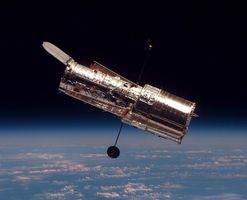
     content words:    Hans Lippershey, When Galileo, Sir Isaac Newton, Hubble Space Telescope


Print Telescopes Over Time
edHelper.com subscriber options:
     Print Telescopes Over Time  (font options, pick words for additional puzzles, and more)

     Quickly print reading comprehension

     Print a proofreading activity


Feedback on Telescopes Over Time
     Leave your feedback on Telescopes Over Time  (use this link if you found an error in the story)


Telescopes Over Time
By Mary Lynn Bushong
  

1     Do you ever stand outside at night and look at the stars? Do you know the names of the biggest ones? Do you know which ones are planets?
 
2     People have been looking up at the stars for a long time. For most of that time all they had were their eyes. Then in 1608 the spy glass was invented by Hans Lippershey of the Netherlands.
 
3     He used two lenses to help make objects at a distance seem a little bit closer. When Galileo saw the spy glass, he saw more potential in it than just a spy glass. An avid stargazer, he finally had a tool he could use to get a better look skyward.
 
4     He immediately began modifying the spy glass into a telescope. The first was only a 3x telescope, but soon he was making them up to 32x. With these distance viewers, he was able to see mountains and valleys on the moon. He was also the first to see Jupiter's four moons.
 
5     In 1611, Kepler made a telescope using both convex ocular and objective. The result was an inverted or upside down image. Astronomers did not mind because it made the image brighter.
 
6     In 1686, Huygens built an outdoor telescope using convex lenses. They increased the focal length so he could clearly see the rings around Saturn.
 
7     Sir Isaac Newton made his own changes to telescopes in the 1680's when he used a metal mirror. With it, he created the first reflecting telescope. The mirror eliminated the problem of chromatic aberration.
 
8     Chromatic aberration refers to the points on an optical axis where the different colors of light come into focus. Have you ever looked at something through a lens and seen circles of color around an object? That is chromatic aberration.
 
9     The reflector caused a lot of excitement, but it was hard for others to copy. The mirror also tarnished so images could not be seen.

Paragraphs 10 to 16:
For the complete story with questions: click here for printable


Copyright © 2008 edHelper