edHelper.com
Canadian Theme Unit


The Ojibwa


The Ojibwa
Reading Level
     edHelper's suggested reading level:   grades 6 to 7
     Flesch-Kincaid grade level:   6.69

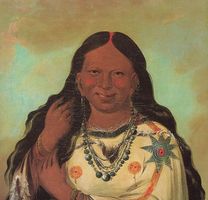
Vocabulary
     challenging words:    longtime, story-telling, wampum, lacrosse, eighteenth, tended, staple, coordination, provided, original, originally, wounds, afterward, territory, mainly, caption
     content words:    Plains Ojibwa, George Catlin, Great Lakes, This First Nations, North America, Iroquois Confederacy, North Dakota, In Canada, First Nations


Print The Ojibwa
edHelper.com subscriber options:
     Print The Ojibwa  (font options, pick words for additional puzzles, and more)

     Quickly print reading comprehension

     Print a proofreading activity


Feedback on The Ojibwa
     Leave your feedback on The Ojibwa  (use this link if you found an error in the story)


The Ojibwa
By Mary Lynn Bushong
  

1      Caption: A woman of the Plains Ojibwa. Painted in 1832 by George Catlin
 
2     When French voyageurs arrived around the Great Lakes, they found many small villages. This First Nations tribe quickly grew into one of the largest tribes in North America. As guides and allies of the French, the Ojibwa became a force to be reckoned with.
 
3     The Ojibwa were originally a woodlands farming people. They hunted deer and used snares to catch smaller animals like rabbits. They used pronged spears to catch some fish and baited bone hooks with sinew lines to catch others.
 
4     They also grew corn and harvested wild rice. The Ojibwa were famous for their birch bark canoes. One man would slowly paddle the canoe through the rice plants, while a woman would use a stick to beat the grains into the boat. Some grains were always left behind to start new plants. They also grew squash and beans.
 
5     Although life was filled with work, there were times for games, too. Smaller children played with toys, while older boys and men played lacrosse. It was a game of skill that helped keep bodies fit while increasing strength and coordination.
 
6     It was mainly the Ojibwa women who were farmers. They planted and tended the crop. Those who had babies carried them on a cradle board on their backs.
 
7     Before the Ojibwa had access to cloth through traders, their clothes were made of animal skins. Afterward they often wore skirts and blouses which were decorated with beautiful beaded flower patterns. The Ojibwa became well-known for their bead work.
 
8     Men were the hunters and warriors of each tribe. Some jobs were shared, like story-telling and treating wounds or illness.

Paragraphs 9 to 17:
For the complete story with questions: click here for printable


Copyright © 2008 edHelper